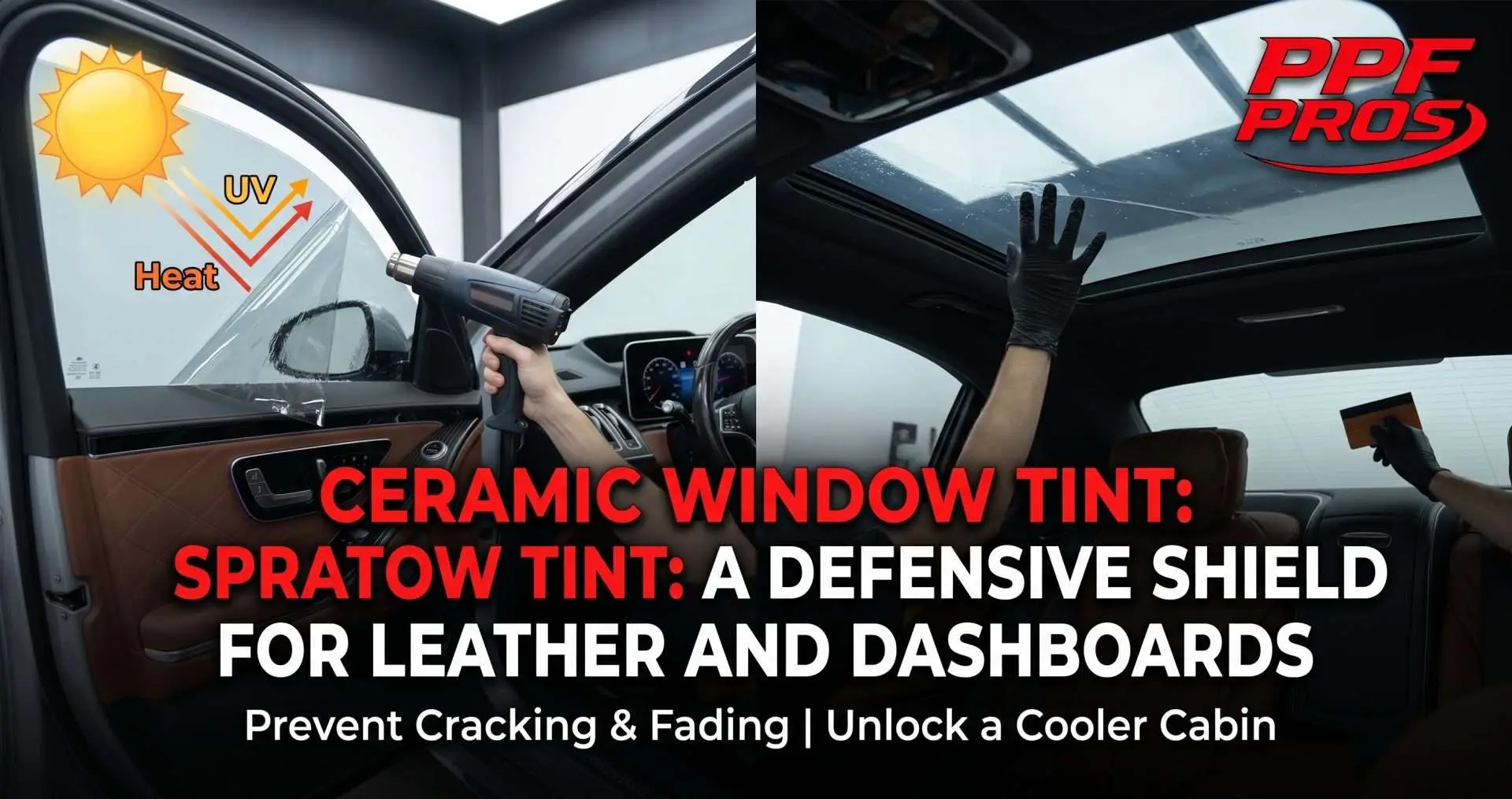
Many car owners wonder, will ceramic window tint protect from leather cracking and dashboard fading? The short answer is yes: high-grade ceramic window film blocks the specific solar elements responsible for drying out leather hides and bleaching interior plastic trims. By filtering out destructive light and trapping ambient heat outside, ceramic tint acts as a long-term shield for your vehicle’s cabin.
Does Ceramic Window Tint Really Protect Your Car’s Interior?
Yes, premium ceramic window tint provides exceptional protection against interior automotive wear. Unlike basic privacy glass or cheap dyed films, nano-ceramic window tint targets the root causes of material breakdown: ultraviolet (UV) radiation and infrared (IR) heat.
When installed correctly, high-performance ceramic film delivers two essential defensive metrics:
- 99%+ UV Ray Blockade: UV light acts as a constant bleach on dyes and breaks down protective chemical topcoats on leather and vinyl.
- Up to 98% Infrared Heat Rejection: IR light creates extreme cabin heat, which bakes interior surfaces, expands materials, and evaporates natural moisture.
By cutting off both solar threats simultaneously, ceramic film significantly slows down interior aging, keeping leather supple and dashboards crack-free for years.
The Science of Solar Damage: Why Leather Cracks and Dashboards Fade
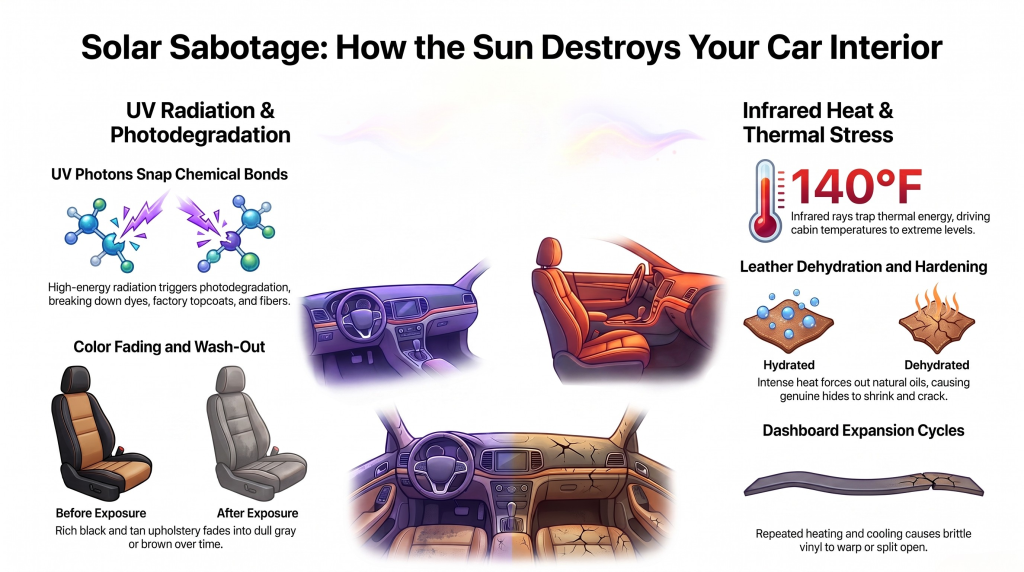
To understand how window tint helps, it helps to know what happens to your vehicle’s interior when parked under direct sunlight.
How UV Rays Break Down Materials
Ultraviolet radiation carries high energy. When UV photons strike your dashboard or leather seats, they trigger a chemical reaction called photodegradation. This process snaps the chemical bonds inside dyes, factory topcoats, and underlying fibers. Over time, rich black or tan upholstery fades into dull gray or washed-out brown.
The Role of Infrared Heat
While UV light causes fading, Infrared (IR) rays deliver heat. When sun shines through untreated glass, thermal energy builds up inside the vehicle, creating an oven effect where cabin temperatures can exceed 140°F.
- Leather: Extreme heat forces natural oils and moisture out of genuine hides, causing the leather to shrink, harden, and crack under routine weight.
- Dashboards: Vinyl and molded plastics expand when hot and contract when cooled. Repeated daily expansion cycles cause brittle dashboards to warp, split, or split open near air vents.
How Ceramic Window Tint Acts as a Thermal Shield for Your Cabin
Ceramic window film uses non-metallic, nano-ceramic particles embedded directly into the film layers. These microscopic particles are tiny enough to remain completely invisible to the human eye, preserving optical clarity while selectively filtering out solar radiation.
Sunlight Rays ──> [ Untreated Glass ] ──────> Extreme Heat + UV ──> Cracked Leather & Faded Dash
Sunlight Rays ──> [ Ceramic Film Layer ] ───> 99% UV Blocked    ──> Supple Leather & Protected Cabin
                                          └─> Up to 98% IR Rejected
Key Benefits of Ceramic Defense:
- Preserves Factory Dyes: Keeps interior colors vibrant without chalking or fading.
- Protects Delicate Stitching: Prevents thread dry-rot on seats and steering wheels.
- Prevents Vinyl Outgassing: Stops dashboard plastics from releasing gases that leave a greasy haze on the inside of your windshield.
- Reduces A/C Strain: A cooler interior cools down much faster, reducing fuel and battery strain on hot days.
Ceramic Tint vs. Other Window Films: Which Offers the Best Protection?
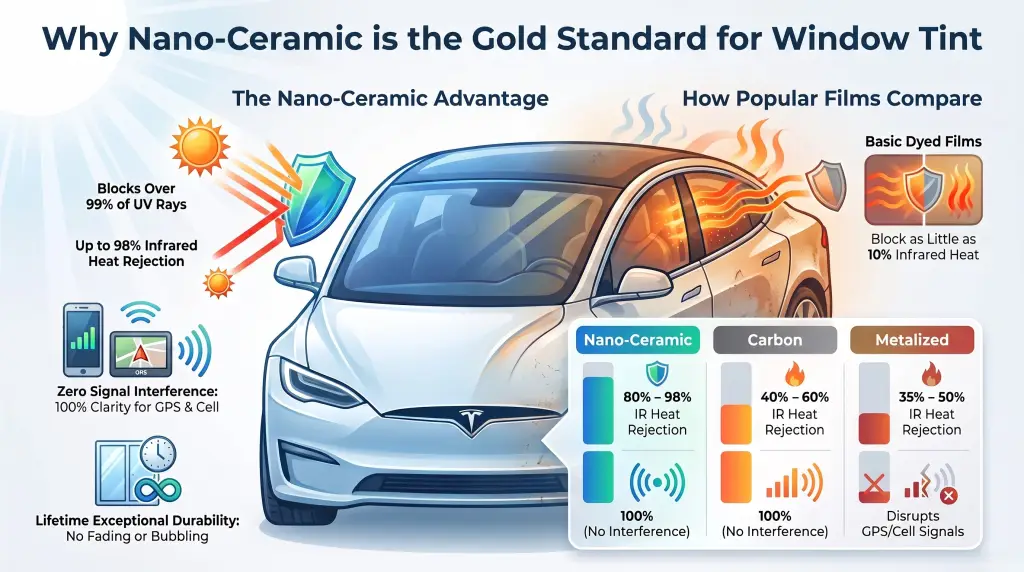
Not all window films offer the same level of interior protection. Here is how popular tint types compare:
| Tint Type | UV Protection | IR Heat Rejection | Electronic Signal Clarity | Long-Term Durability |
| Nano-Ceramic | 99%+ | 80% – 98% | 100% (No Interference) | Lifetime / Exceptional |
| Carbon | 99% | 40% – 60% | 100% (No Interference) | High |
| Metalized | 98% | 35% – 50% | Disrupts GPS/Cell Signals | Moderate |
| Basic Dyed | 90% – 95% | 10% – 20% | 100% (No Interference) | Low (Fades to Purple) |
While budget dyed films make windows darker, they fail to stop IR heat. Nano-ceramic tint remains the gold standard for full interior preservation.
The Front Windshield Vulnerability: Protecting Your Highest-Risk Surface
Many drivers tint their side and rear windows but leave the front windshield completely clear. Unfortunately, the windshield is the largest piece of glass on your car and sits directly above your dashboard.
       [Direct Sunlight]
               │
               ▼
   /───────────────────────
  /  Front Windshield         <-- Receives up to 70% of direct heat
 /
/─────[ Exposed Dash ]────────
Why Clear Ceramic Windshield Tint Is Essential
- Maximum Exposure: The dashboard takes up to 70% of direct solar heat throughout the day.
- High-Visibility Films: You do not need dark glass to get heat protection. Clear ceramic films (such as 70% or 80% VLT) allow optical transparency for night driving while blocking up to 90%+ of IR heat.
- Legal Compliance: Clear ceramic windshield films provide protection while maintaining legal visibility standards in most jurisdictions.
Ceramic Tint vs. Factory Privacy Glass: The Common Myth Exposed
A common misconception among SUV, truck, and Tesla owners is that dark factory rear glass already provides full sun protection.
The Reality: Factory privacy glass is simply dark-dyed glass designed for privacy. It lacks the nano-ceramic coatings necessary to block infrared heat or high-energy UV rays.
Without adding a high-performance ceramic film over factory tinted glass, solar heat still passes into the cabin, exposing rear leather seats and door panels to thermal damage.
Realistic Expectations: What Ceramic Window Tint Can and Cannot Do
While ceramic film is a powerful preventative measure, understanding its limits helps set accurate expectations:
What Ceramic Tint CAN Do:
- Slow down interior aging by up to 90%.
- Prevent new cracks, hardening, and color fading.
- Keep leather supple when paired with routine conditioning.
What Ceramic Tint CANNOT Do:
- Reverse or repair existing leather cracks or split dashboards.
- Eliminate 100% of heat during prolonged parking in 100°F+ weather (though it significantly reduces heat ramp-up speed).
Complete Interior & Exterior Protection: The PPF Pros Approach
At PPF Pros, based in North Hollywood, vehicle care goes beyond standard tinting. Complete interior and exterior preservation requires a balanced maintenance routine:
- Install High-Grade Ceramic Film: Cover all glass surfaces—including the front windshield and panoramic sunroofs—with top-tier ceramic tint.
- Condition Leather Regularly: Apply a high-quality leather conditioner every 3 to 6 months to maintain essential moisture.
- Clean Tint Correctly: Use ammonia-free glass cleaners and soft microfiber towels to protect the film’s scratch-resistant topcoat.
- Protect Exterior Paint: Combine interior tint with XPEL Paint Protection Film (PPF) and Ceramic Coatings to safeguard paintwork against rock chips, bird droppings, and UV oxidation.
Financial Breakdown: Ceramic Tint Cost vs. Interior Restoration & Resale Value
Investing in ceramic window tint is far more cost-effective than repairing sun damage down the road:
- Full Vehicle Ceramic Tint: Typically ranges from $400 to $900 depending on vehicle size and coverage.
- Dashboard Replacement: Replacement parts and labor can easily cost between $1,200 and $3,500.
- Leather Re-Upholstery: Re-covering worn leather seats can cost $800 to $2,500+ per row.
Beyond avoiding costly repairs, preserving a clean, original interior helps maintain a significantly higher trade-in or resale value.
Protect Your Interior with PPF Pros in Los Angeles
When driving in Southern California, protecting your vehicle from relentless sun exposure is essential. PPF Pros delivers precise, clean window film installations for daily drivers, Teslas, luxury vehicles, and exotics across Los Angeles.
Why Drivers Choose PPF Pros:
- XPEL Authorized Installers: Using industry-leading films backed by comprehensive warranties.
- Precision Fitment: Clean-cut alignments and wrapped edges without rough seams.
- 5-Star Service: Trusted local support in North Hollywood with hundreds of satisfied clients.
Frequently Asked Questions (People Also Ask)
1. Will ceramic tint stop my leather seats from getting hot?
Yes. While no film eliminates heat entirely in a closed car, ceramic tint blocks up to 98% of infrared heat. This prevents seat leather from becoming scorching hot to the touch.
2. Is clear ceramic tint as effective at blocking heat as dark ceramic tint?
Yes! Ceramic heat rejection comes from invisible nano-particles, not dark dyes. A 70% clear ceramic windshield film can reject as much infrared heat as a dark 15% tint.
3. Does ceramic window tint fade or turn purple over time?
No. Cheap dyed films turn purple because their dyes break down under UV light. Quality ceramic films use inorganic ceramic particles that do not fade or discolor.
4. Should I tint my panoramic glass roof with ceramic film?
Absolutely. Panoramic glass roofs allow massive amounts of heat into the cabin. Applying ceramic tint overhead dramatically drops ambient temperatures and protects rear passengers.
5. Can I clean ceramic tinted windows with regular glass cleaner?
You should only use ammonia-free glass cleaners on tinted windows. Ammonia can break down window film adhesives and clear coats over time.