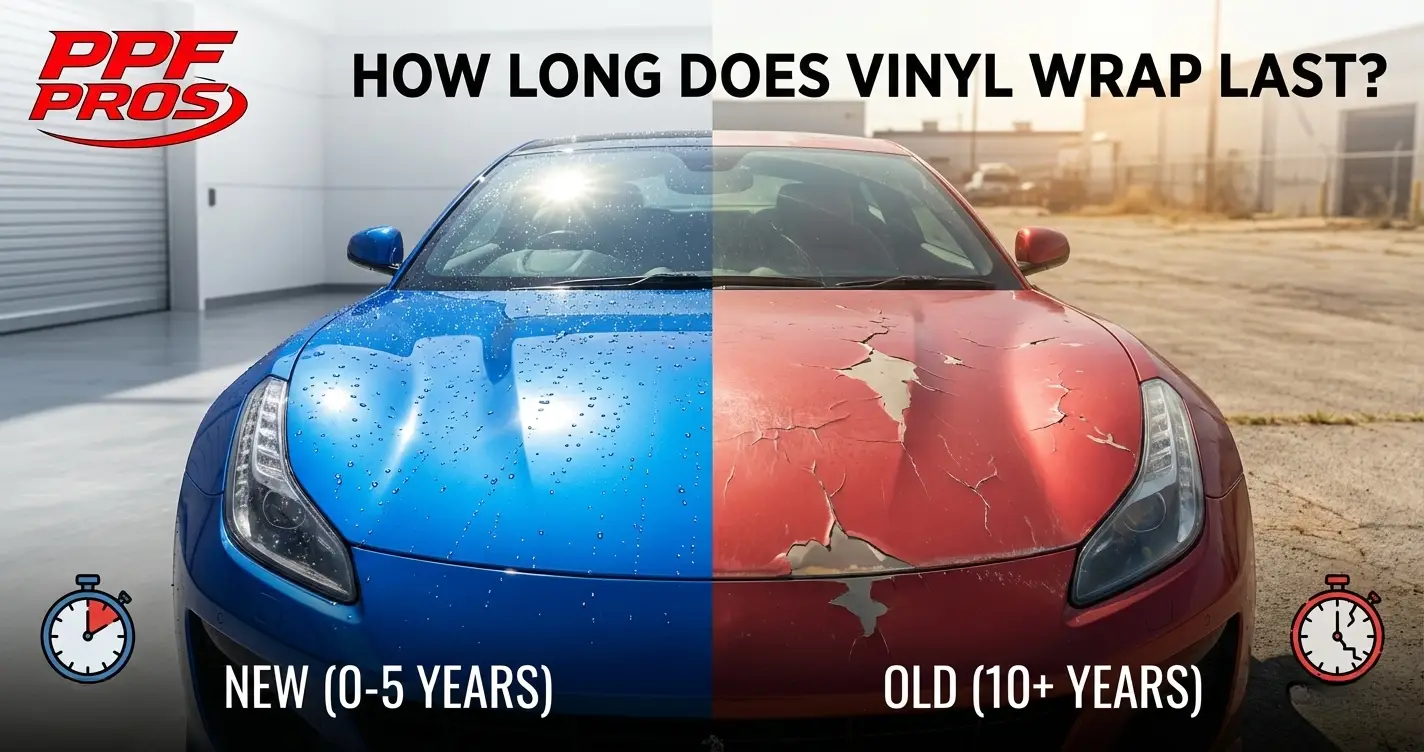
If you are wondering how long does vinyl wrap last on a vehicle, the standard answer is typically five to seven years, but the real-life results depend on how you treat it. A high-quality vinyl wrap is a significant investment that protects your paint and transforms your car’s aesthetic, making it vital to understand the timeline of its durability. In this comprehensive guide, we break down everything from environmental factors to professional maintenance secrets that determine the true life of your vinyl.
Average Lifespan Expectations
For most vehicle owners, a professionally installed, high-quality vinyl wrap will last between 5 and 7 years. However, this isn’t a “set it and forget it” product. The lifespan is a sliding scale based on the quality of the film and how the vehicle is stored.
Professional Grade vs. Economy Vinyl
Not all vinyl is created equal. Premium brands like 3M and Avery Dennison are engineered with advanced UV inhibitors and repositionable adhesives that allow the wrap to stay flexible for years. Conversely, “economy” or “no-name” wraps found on discount sites often use cheaper adhesives that can fail within 12 to 24 months. These budget films often become brittle, making them nearly impossible to remove without damaging your vehicle’s clear coat.
Horizontal vs. Vertical Surfaces
One of the most overlooked factors in wrap longevity is the orientation of the surface. Horizontal surfaces—like the hood, roof, and trunk lid—take a direct hit from the sun’s UV rays and collect more environmental contaminants like bird droppings and acid rain. Because of this constant “baking” effect, the vinyl on your roof may only last 3 to 4 years, even if the vinyl on the vertical side doors looks brand new after 7 years.
Factors That Determine How Long Your Wrap Will Last
Understanding what eats away at your wrap’s integrity can help you extend its life significantly.
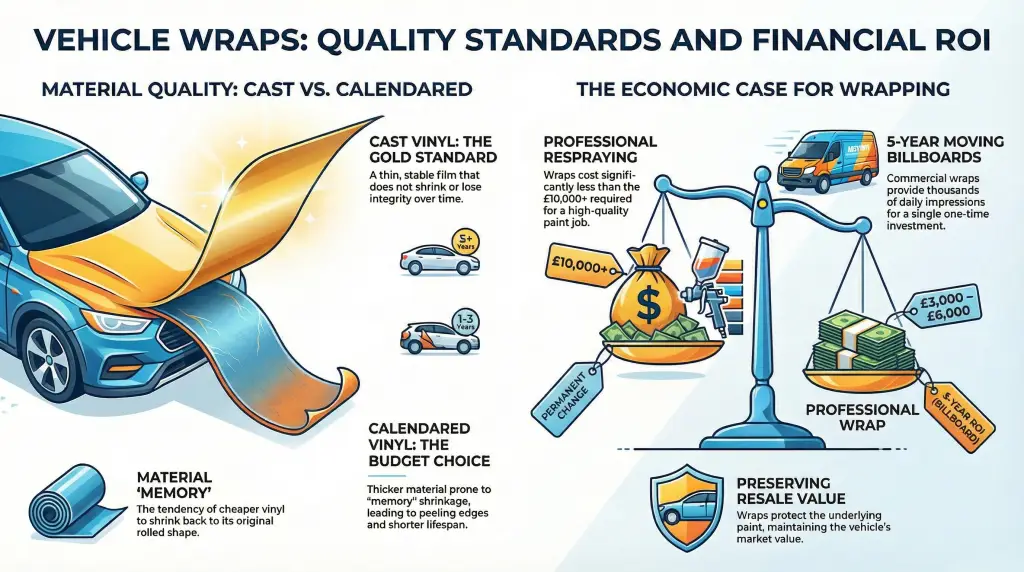
Material Quality: Cast vs. Calendared Film
- Cast Vinyl: This is the gold standard for vehicle wraps. It is manufactured by pouring a liquid mixture onto a casting sheet, resulting in a thin, stable film that doesn’t “shrink” over time.
- Calendared Vinyl: This is thicker and made by rolling the material through heated rollers. While cheaper, it has “memory” and wants to shrink back to its original shape, leading to peeling edges and a shorter lifespan.
The Skill of the Install Crew
Even the best film will fail if the installer cuts corners. Proper “post-heating” is a technical process where the installer uses a heat gun to “set” the vinyl into the deep curves of the car. If this isn’t done, the vinyl will eventually lift. PPF Pros specializes in precision installation, ensuring that every edge is tucked and every contour is heat-set for maximum durability.
Environmental Exposure: Sun, Salt, and Humidity
If you live in a coastal area, salt air can be corrosive to vinyl adhesives. Similarly, in regions with high humidity, moisture can get trapped under lifting edges, leading to premature failure.
The “Finish” Factor: Why Matte and Chrome Last Less
The texture of your wrap changes its chemistry.
- Gloss finishes are the most durable because they have a smooth top layer that sheds dirt and reflects UV rays.
- Matte and Satin finishes have a microscopic “rough” texture to catch light; unfortunately, this also catches dirt and pollutants.
- Chrome wraps are the most delicate. They are composed of multiple layers, including a foil-like layer that can delaminate or “fog” much faster than standard colors, usually lasting only 2 to 3 years.
How Climate Impacts Your Wrap’s Expiration Date
Your geography is perhaps the biggest “silent killer” of vinyl.
High-UV Regions vs. Winter Climates
In “Sun Belt” states like Arizona or Florida, the intense UV index acts like a slow-motion microwave for vinyl. The heat breaks down the plasticizers in the film, leading to fading and cracking. Conversely, in northern climates, the primary threat is road salt and magnesium chloride. These chemicals are highly abrasive and can eat through the finish of the wrap if not washed off weekly.
The Impact of “Garaging” vs. Street Parking
A car that lives in a climate-controlled garage will almost always hit the 7-year mark. A car parked on the street 24/7, exposed to sap, bird droppings, and the morning dew-to-afternoon-sun cycle, may see its wrap begin to degrade in as little as 3 years.
How to Maximize the Life of Your Vinyl Wrap
You have more control over your wrap’s lifespan than you think. Proper care is the difference between a wrap that looks “tired” in two years and one that looks “fresh” in five.
The Golden Rules of Cleaning
Avoid automatic brush car washes at all costs. The abrasive bristles can create microscopic scratches or catch the edge of the vinyl and tear it.
- Hand Washing: Use a pH-neutral soap and a soft microfiber mitt.
- Pressure Washing: If you use a pressure washer, keep the nozzle at least 12 inches away from the surface and never aim it directly at a seam or edge.
Recommended Sealants and Ceramic Coatings
One of the best ways to “hack” the lifespan of your wrap is to apply a ceramic coating on top of the vinyl. Ceramic coatings, like those offered by PPF Pros, provide a sacrificial layer that absorbs UV damage and makes the surface hydrophobic. This prevents “staining” from bird droppings and makes cleaning much easier.
Signs It’s Time to Replace Your Wrap
Knowing when to say goodbye to your wrap is essential for protecting the paint underneath.
Cracking, Fading, and “Browning”
Fading is usually the first sign of UV failure. However, if you see “browning” (especially on the hood), this is a sign that the vinyl is literally burning. Once it begins to crack into small, “alligator skin” patterns, it has reached the end of its life.
The “Hardening” Phase
If you wait until the wrap is brittle and cracking to remove it, you have waited too long. Over time, the adhesive bonds more permanently to the clear coat. If the vinyl becomes “hard,” it will come off in tiny, dime-sized pieces during removal, which significantly increases labor costs and increases the risk of pulling the vehicle’s paint.
Does Vinyl Wrap Protect or Damage the Underlying Paint?
When installed and removed correctly, vinyl wrap acts as a protective skin. It shields your paint from minor rock chips and UV fading.
The 10-Year Rule
Most manufacturers guarantee “clean removability” for up to 5 or 7 years. If you leave a wrap on for 10 years, the adhesive can chemically merge with the clear coat. To avoid this, we recommend a professional inspection at the 5-year mark. PPF Pros uses specialized heat-removal tools to ensure your factory paint remains pristine during the transition.
Cost vs. Longevity: Is a Wrap Worth the Investment?
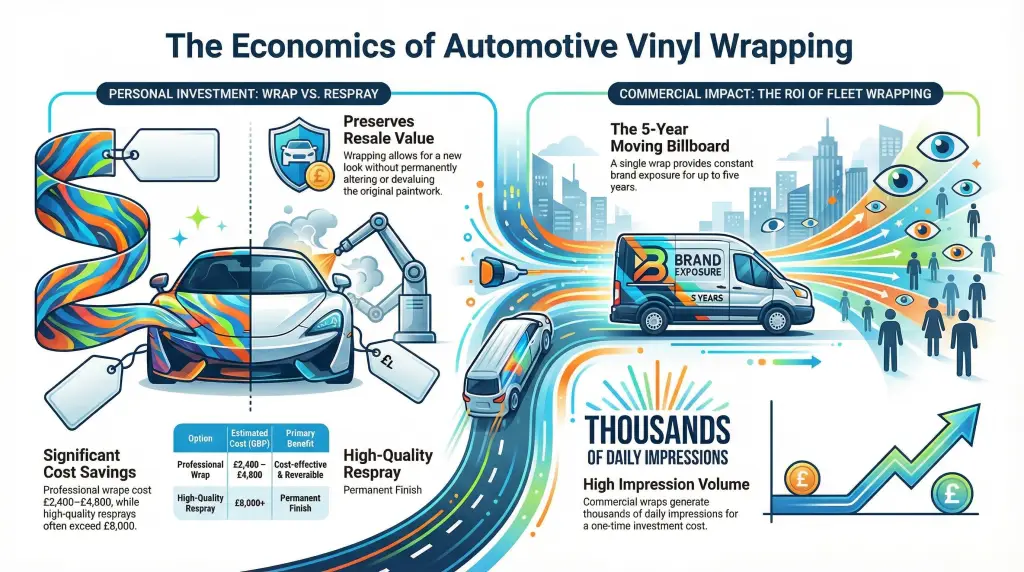
A professional wrap typically costs between $3,000 and $6,000. When compared to a high-quality respray—which can cost upwards of $10,000—a wrap is a cost-effective way to change your car’s look while preserving its resale value. For commercial fleets, the ROI is even higher; a wrap acts as a 5-year moving billboard, providing thousands of impressions for a one-time cost.
People Also Ask (FAQ)
Can I take my wrapped car through a car wash?
It is highly discouraged. Touchless car washes are okay occasionally, but hand washing is the only way to ensure the edges stay sealed and the surface stays scratch-free.
Does vinyl wrap fade in the sun?
Yes, all vinyl will eventually fade due to UV exposure. Using a ceramic coating or UV-protectant spray can significantly slow this process down.
How long does wrap last on interior trim?
Because interior trim isn’t exposed to the sun or road debris, an interior wrap can easily last 10 years or the lifetime of the vehicle.
Can a vinyl wrap be repaired if it gets scratched?
You cannot “buff out” a scratch in vinyl like you can with paint. Usually, the entire affected panel (like a door or fender) must be re-wrapped to ensure a seamless look.
Does ceramic coating actually double the wrap life?
While it may not exactly double the years, it significantly extends the “aesthetic life.” It prevents the fading and staining that usually force owners to replace their wraps early.
Will the wrap peel off when I’m driving?
No. If the wrap is installed by professionals like PPF Pros, the edges are tucked and post-heated to ensure they stay secure even at highway speeds.
Protect Your Investment with PPF Pros
How long your vinyl wrap lasts is a combination of the quality of the film, the precision of the installation, and your commitment to maintenance. By choosing premium materials and adding protective layers like ceramic coating, you can enjoy a head-turning vehicle for many years to come.
Don’t leave your car’s finish to chance. Whether you’re looking for a bold color change or want to maximize the life of your current wrap, the experts at PPF Pros are here to help.
Ready to give your car a professional transformation? Visit PPF Pros today for a custom quote!