Partial PPF covers the highest-impact strip of your front end: bumper, headlights, mirrors and roughly the first 18 to 24 inches of the hood and fenders. Full PPF covers whole panels, either the entire front (full front) or every painted surface (full vehicle). Partial costs less and installs faster. Full gives you no visible film edge across the middle of the hood and protects far more paint. Which one is right depends on your paint color, how you drive, and how long you will keep the car.
Below we walk through each tier, what it protects, what it costs at our North Hollywood shop, and how to decide without overbuying or regretting a cheap choice later.
TL;DR
- Partial front protects the bumper, headlights, mirrors and the leading 18 to 24 inches of hood and fenders. It is the entry tier and the best value for a leased or short-term daily driver.
- Full front wraps the whole hood, both fenders, bumper and mirrors in film, so there is no seam across the paint. At our shop it is $2,199.
- Track Pack adds coverage beyond the front for cars that see high-speed or track-day debris. Full vehicle covers every painted panel and starts at $4,500.
- Dark paint, new cars you plan to keep, and high resale value all push the decision toward full coverage.
Table of Contents
- What each PPF coverage level actually covers
- Partial vs full: how to decide
- The seam: the real trade-off
- What PPF does and does not do
- Our perspective: where partial makes sense, and where we say no
- What PPF costs: reading the numbers fairly
- Adding ceramic coating or a different finish
- Book a quote
- FAQ
- Sources
What each PPF coverage level actually covers
Paint protection film is a clear urethane layer applied over factory paint. The coverage names are shop shorthand, so exact panel lists vary a little from one installer to the next. Ask for the panel list in writing. Here is how the tiers generally break down.
| Coverage | Typically covers | Best for | Our price |
|---|---|---|---|
| Partial front | Front bumper, headlights, mirror caps, leading 18 to 24 in. of hood and fenders | Budget-minded daily drivers, leases | Custom quote |
| Full front | Entire hood, both full fenders, front bumper, mirrors, headlights | Owners keeping the car for years, dark paint | $2,199 |
| Track Pack | Full front plus extra high-impact areas for fast driving | Track days, canyon and freeway-heavy drivers | Custom quote |
| Full vehicle | Every painted exterior panel | New luxury or exotic cars, long-term ownership | From $4,500 |
The film itself is thin. 3M’s Pro Series brochure describes a 0.203 mm, ultra-transparent, self-healing polyurethane film, which is why a well-installed job reads as paint rather than plastic. We install XPEL as an authorized installer, and the principle is the same: the film takes the hit so the paint does not.
Partial front: the entry tier
Partial front targets the places a rock is most likely to strike: the bumper face, the leading edge of the hood, the front of the fenders and the mirrors. It is the cheapest and quickest package, and it covers most of what a typical commuter sees on the freeway.
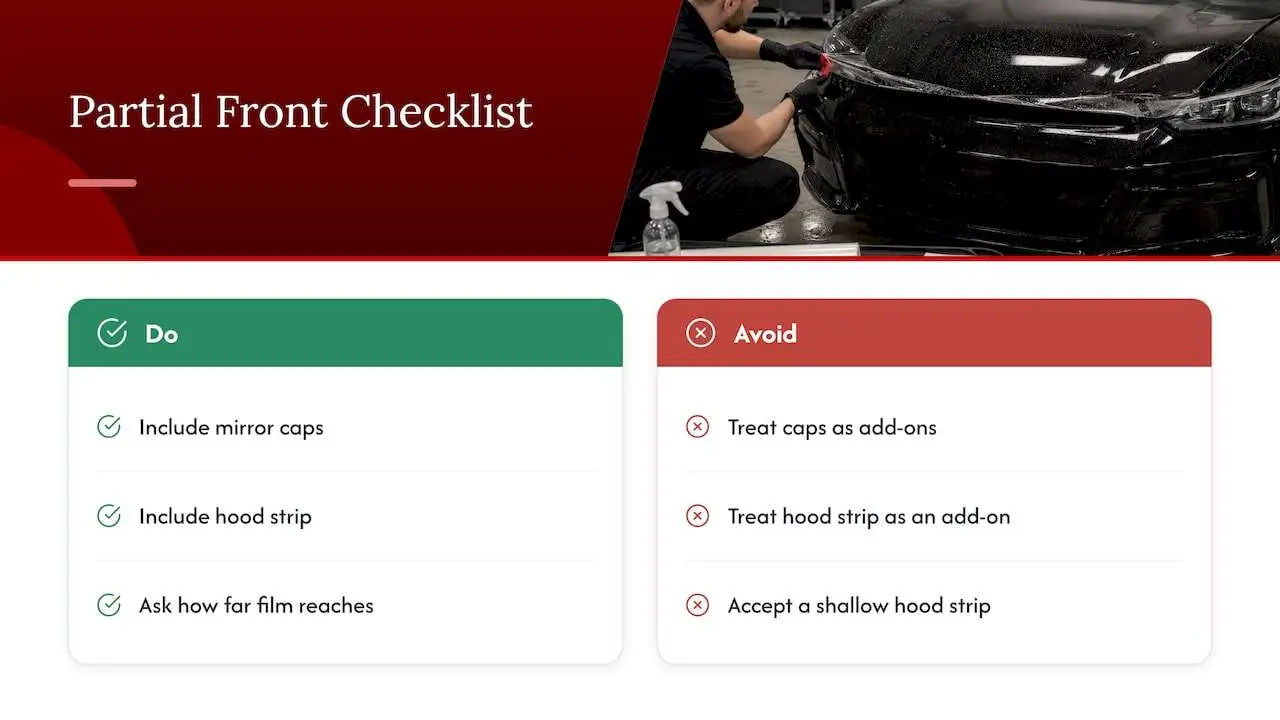
Two things to insist on if you go partial. First, mirror caps and the hood strip should be included, not treated as add-ons. Second, ask how far up the hood the film goes. A strip that is too shallow leaves chips just beyond the edge, which defeats the point.
Full front: the version most owners keep
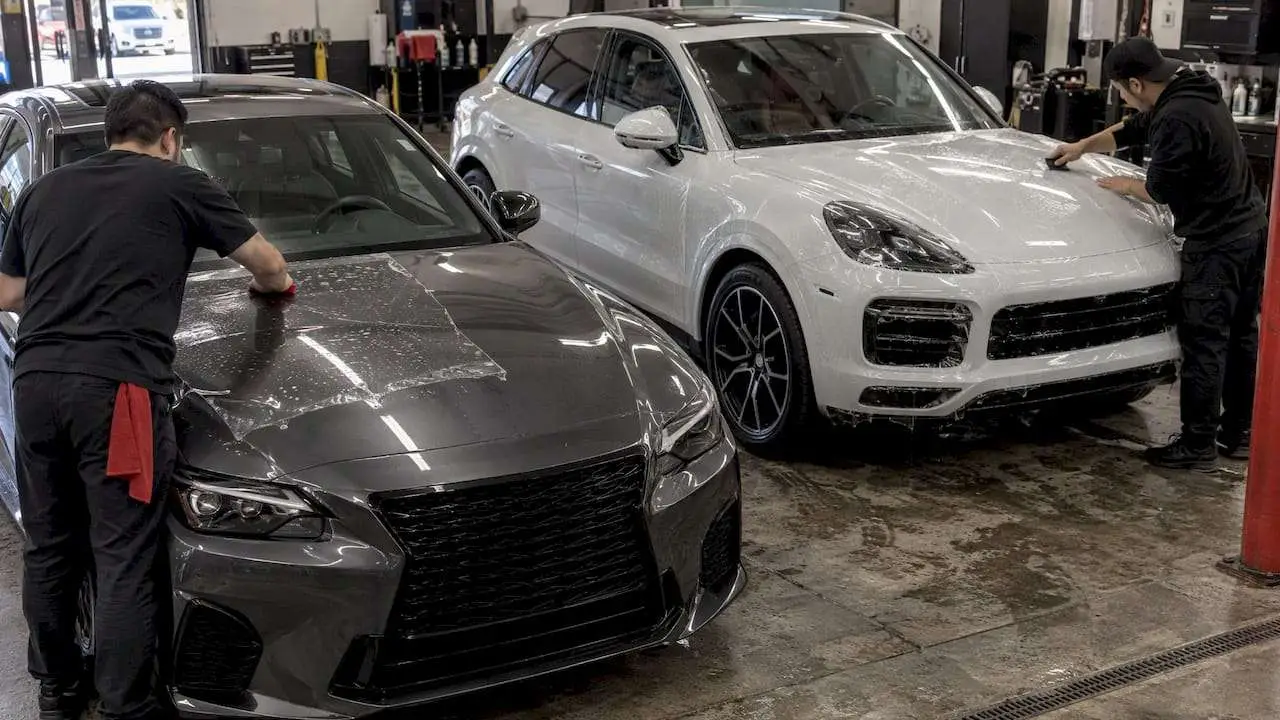
Full front film covers the whole hood, both full fenders, the bumper, headlights and mirrors. Because every one of those panels is covered edge to edge, you do not get a line crossing the paint. We publish this one at $2,199, and it is the package we point most new-car owners to. If you want the longer breakdown, see our guide to full front PPF and whether it is worth it.
Track Pack: for faster, harder driving
Track Pack is built for cars that take more abuse than a commute delivers: sustained high speeds, tire debris and tar on track days, or regular canyon runs. It builds on the front-end coverage with additional panels exposed to debris. Because the right panels depend on the car and how you use it, we quote Track Pack per vehicle rather than list a flat price. Tell us what you drive and where, and we will lay out which extra panels earn their cost.
Full vehicle: every painted panel
Full vehicle PPF covers all painted surfaces, including doors, quarters, roof and rear. It starts at $4,500, and the final figure depends on the vehicle’s size and complexity. It is the right call for a new exotic or luxury car you plan to keep, or any car where flawless original paint is part of the value. Our page on full body PPF coverage, cost and value goes deeper.
Partial vs full: how to decide
Price is the obvious difference, but it is rarely the deciding one. These five questions usually settle it.
1. What color is the paint?
Partial film ends somewhere in the middle of a large, visible panel. On a light silver or white car, that edge is nearly invisible. On black, deep blue or any dark metallic, it is easier to spot, especially in direct sun. Over time, wax and dirt can collect along a mid-panel edge and make it more noticeable. That is the main reason we steer owners of dark cars toward full front.
2. How long will you keep the car?
If you are leasing for three years, partial front is often enough. If you plan to keep the car for eight or ten, you will drive the front end through a long run of freeway miles and construction zones. Covering the whole front once costs less than repainting a hood and fenders later.
3. Where do you drive?
Los Angeles drivers spend a lot of time on freeways with gravel trucks, construction and road debris. Highway speed is what turns small stones into chips. If your miles are mostly surface streets at low speed, partial is easier to justify. If you commute on the 101, 405 or 5, lean full front.
4. What is the car worth?
A chipped hood on an economy car is an annoyance. On a luxury or exotic car, it can mean a repaint, and a repainted panel can affect value when you sell. The higher the car’s value, the less sense it makes to leave unprotected paint in the middle of a panel.
5. Do you use the car hard?
Track days and spirited driving throw more debris at the car, and from more angles. That is the case for Track Pack or full vehicle rather than a front-only package.
The seam: the real trade-off
With partial front, the film stops partway across the hood and fenders, and the edge is wrapped or trimmed to follow the body lines as cleanly as possible. A good installer makes it very hard to see. It will still exist, though, and a few things follow:
- The edge can catch wax or dirt if you hand-wax carelessly.
- It shows more on dark paint than on light paint.
- The paint just beyond the edge is still exposed, so a chip right past the line is possible.
Full front removes those issues by running film to the panel edges, where the factory gaps hide the termination. That is the trade you are buying: roughly the difference in price for a cleaner look and complete coverage on the panels most exposed to the road.
What PPF does and does not do
Film is not a force field. It stops rock chips, bug acids, road grime and light abrasion from reaching the paint. Modern premium film also self-heals. According to XPEL’s care guidance, light scratches and swirl marks can disappear with heat from sunlight or warm water, while deep scratches that cut through the film cannot self-heal and may call for replacing the panel’s film.
Care is simple, and it is the same whichever coverage you choose:
- Wait 48 hours after installation before washing the car, as XPEL’s guidance says.
- Remove bug splatter and other stains promptly instead of letting them bake in.
- Wash by hand or in a touchless setup, and avoid harsh solvents on the film.
Film also does not fix existing damage underneath. It locks in whatever paint condition it covers, so prep matters. Read what paint correction before PPF involves before you book, particularly if the car is not brand new.
Our perspective: where partial makes sense, and where we say no
We install film all week, and the pattern is consistent. Owners who choose the cheapest option because it saves money today often come back wishing they had covered the full panel. Owners who buy the biggest package for a car they will trade in after two years often overspend.
So we do not push the top tier by default. Here is how we talk it through at the shop:
- Partial front is a fine call for a lighter-colored daily driver, a lease, or a tight budget. It still takes the brunt of the stone hits, and we will tell you plainly where the film edge will sit.
- Full front is our default for dark paint, new Teslas and luxury cars, and anything you plan to keep. You pay once, and the hood and fenders have no seam to think about.
- Track Pack or full vehicle belongs on cars driven hard or valued highly, where side and rear panels matter as well.
What we care most about is the install: precise cuts, wrapped edges and clean alignment, using XPEL film. A great partial install beats a sloppy full one. Whatever coverage you pick, ask any shop to show you edge work on a finished car before you commit.
— Jake
What PPF costs: reading the numbers fairly
Published prices at our shop: Full Front is $2,199, Full Vehicle starts at $4,500 and Full Color Change Wrap starts at $2,800. Partial Front and Track Pack are quoted per vehicle, because panel shapes, bumper complexity and your use case change the film and labor involved.
When comparing quotes across shops, check these before looking at the total:
- Which film brand and line is being used, and whether the installer is authorized by the manufacturer.
- Exact panels covered, listed by name. “Front package” means different things in different shops.
- Edge approach: wrapped edges or cut at panel lines.
- Paint prep: whether decontamination and any needed correction are included.
- Add-ons such as a ceramic coating over the film, and whether they are priced separately.
For a wider look at market pricing, our article on how much paint protection film usually costs lays out the factors that move a quote.
Adding ceramic coating or a different finish
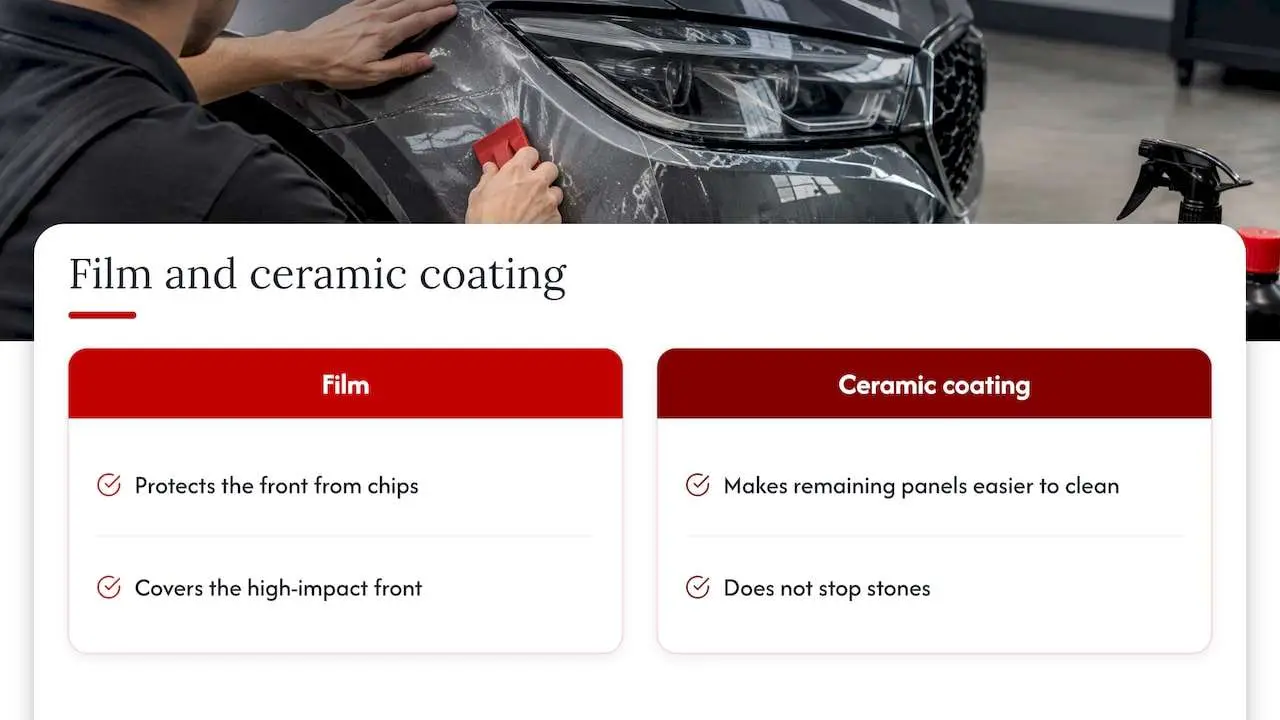
Many owners pair film with a ceramic coating on the rest of the car. The film protects the high-impact front from chips, and the coating makes the remaining painted panels easier to clean. They do different jobs: a coating does not stop stones. If you are weighing the two, our PPF vs ceramic coating comparison explains it. You can see all of your coverage choices side by side in our guide to PPF coverage options from partial front to full body.
Book a quote
If you are still torn between partial and full, send us the year, make, model and color of your car and how you drive it. We reply the same day with a recommendation and a clear quote. You can see the packages and request pricing on our paint protection film page, or go straight to the Full Front package at $2,199. Our shop is in North Hollywood, and we work on daily drivers, Teslas, luxury and exotic cars.
FAQ
Is partial front PPF worth it?
Yes, if your priority is protecting the most chip-prone areas at the lowest cost. It works especially well on lighter paint and on cars you will not keep long. If the car is dark or you plan to keep it for years, full front usually pays off better.
What is the difference between partial front and full front PPF?
Partial front covers the bumper, headlights, mirrors and the first 18 to 24 inches of the hood and fenders. Full front covers the entire hood, full fenders, bumper and mirrors. The main practical difference is the film edge: partial leaves one across the middle of the panels, while full does not.
What is a Track Pack in PPF?
Track Pack is a coverage tier above full front for cars that see high speeds and more debris, such as track days or fast canyon driving. The panels vary by vehicle, so we quote it per car and list exactly what is covered.
Can PPF be removed or replaced if it gets damaged?
Yes. Film can be removed, and a damaged section can usually be redone. Light scratches self-heal with heat, but deep scratches through the film cannot, and XPEL notes they may require replacing the film on that panel.
Should I choose PPF or ceramic coating?
Choose PPF if rock chips are your main worry, because a coating does not physically stop impacts. A ceramic coating makes washing easier and adds gloss. Many owners put film on the front end and a coating over everything else.