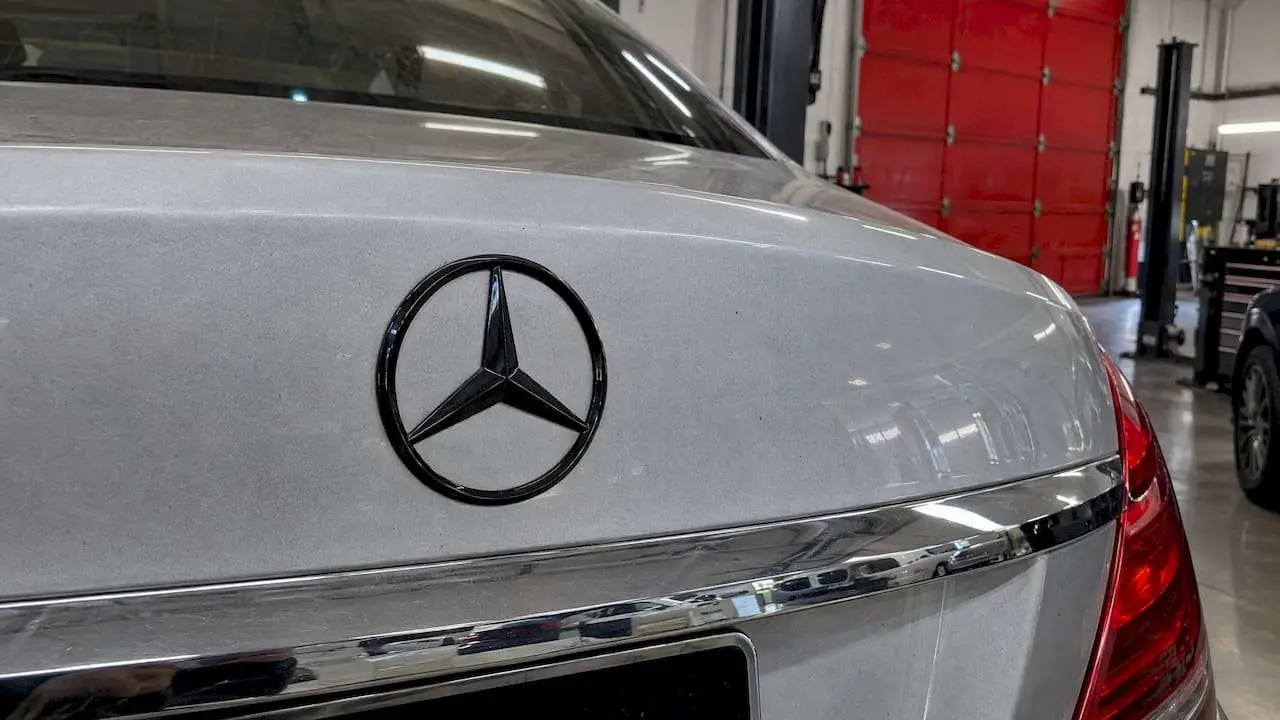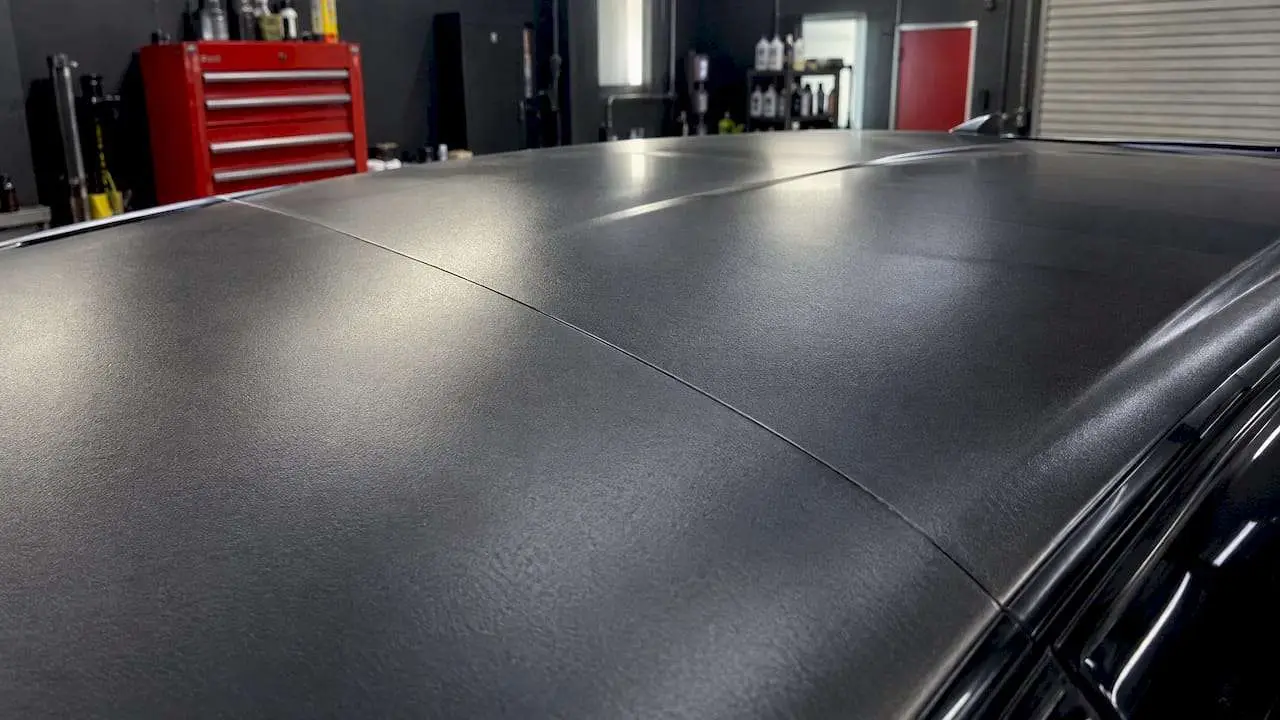

Rear bumper PPF is a clear urethane film that bonds to the painted surfaces at the back of your car, most importantly the flat ledge you drag luggage, groceries and gear across. It takes the scuffs so your paint doesn’t. It is normally planned together with the trunk and surrounding panels rather than sold as a stand-alone sticker, and a professional install is what keeps the edges tight around the curves, sensors and seams that give first-timers trouble.
This guide covers what the film protects, how it differs from a bolt-on guard, what coverage options exist, what an install involves, and how to look after it. We are a North Hollywood shop and we install XPEL paint protection film every week, so we write from the install bay.
TL;DR
- Rear bumper PPF is clear film on the painted bumper, with the loading ledge (the “deck”) as the highest-wear spot. It is a different product from a stainless or ABS plastic guard that sits on top of the bumper.
- Installers usually plan rear coverage across the bumper, trunk and nearby panels so the film flows naturally and ages evenly, instead of treating the bumper in isolation.
- Compound curves, recessed areas, sensor openings and exposed edges are where shortcuts show up as lifting, wrinkles and dirt trapped under the film.
- After install, keep the car dry and unwashed for the film’s cure window (48 hours for most XPEL clear films), and avoid pressure washing the edges.
- Our published prices are $2,199 for Full Front and from $4,500 for Full Vehicle. Rear coverage is quoted to your car, and we reply the same day.
Table of Contents
- What rear bumper PPF actually is
- Rear bumper PPF vs. a rear bumper guard
- What areas of the rear can PPF cover?
- What it costs
- How a rear bumper install works
- Is it worth it for your car?
- Caring for rear bumper PPF after install
- Perspective
- Get rear coverage quoted for your car
- FAQ
- Sources
What rear bumper PPF actually is
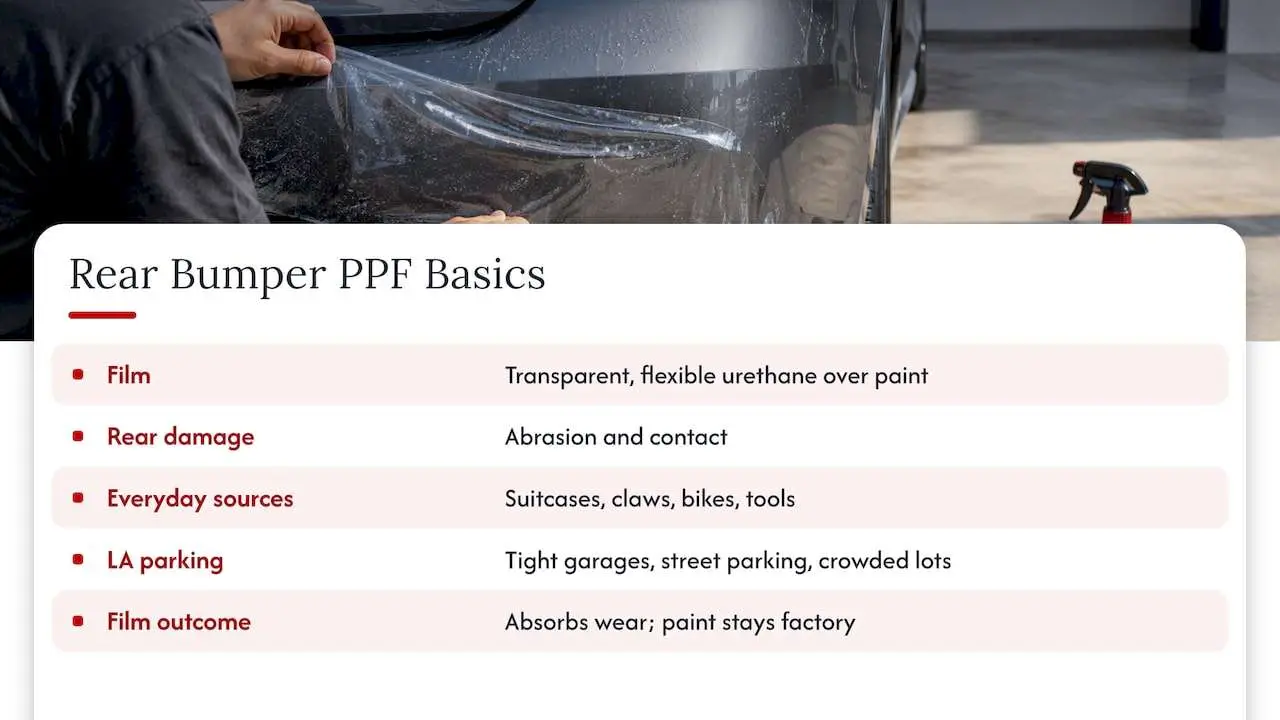
Paint protection film is a transparent, flexible urethane layer applied over factory paint. On the rear of a car, it goes where your paint takes damage that has nothing to do with driving at speed: someone sliding a suitcase out of the trunk, a dog’s claws on the way in, a bike frame, a cooler, a toolbox, a tailgate load of shopping bags with a zipper or buckle.
On the front of a car, rock chips are the headline. At the back, the enemy is abrasion and contact, plus the usual UV, bird droppings, road grime and the fine scratches from hand washing. The film absorbs that wear so the paint underneath stays as the factory made it. When the film eventually looks tired, it can be removed by a professional and replaced.
In Los Angeles, there is one more reason people ask about the rear: parking. Tight garages, street parking and crowded lots mean a lot of light bumps and scrapes at low speed, and rear bumpers sit low and flat where shopping carts, bollards and other cars’ hitches land.
What it will and will not do
We want you to set expectations correctly, and here is how we frame them. PPF is designed to resist chips, scuffs, abrasion and staining on the surface it covers. It is a protective layer, not body armor. A hard impact that dents the bumper cover will dent it with or without film. What the film does well is stop the daily, cumulative surface damage that turns a clean bumper into one that looks tired in a couple of years.
Rear bumper PPF vs. a rear bumper guard
These two get confused because they protect the same loading ledge, but they are different products with different jobs.
A rear bumper protector or guard sits on top of the bumper to shield it from loading damage such as scratches from prams, golf clubs, tools and suitcases. These are usually fixed with automotive tape or fittings and made from stainless steel or high-impact ABS plastic. You can see them and feel them, and they add a visible strip or plate to the back of your car.
PPF is a clear film on the paint itself. Done well, it is close to invisible and follows the contours of the panel.
| Rear bumper PPF | Bolt-on or stick-on guard | |
|---|---|---|
| Look | Clear, follows the panel shape | Visible strip or plate in metal or plastic |
| Where it sits | Bonded to the paint | On top of the bumper surface |
| Coverage | Can extend beyond the ledge to the bumper face, corners and trunk edge | Typically the loading ledge only |
| Fit | Cut to your vehicle’s shape | Sized to a shelf or deck |
| Best for | Owners who want the factory look and broad paint protection | Owners who want a visible, rugged strip on the ledge |
If you want an unbroken factory appearance, which is what most of our Tesla, luxury and exotic customers ask for, film is the choice. It also lets you protect more than the ledge.
What areas of the rear can PPF cover?
The loading ledge is the most common starting point. From there, coverage can grow in sensible steps.
- Luggage strip or loading ledge. The horizontal surface at the top of the rear bumper where items slide in and out. This is the highest-contact zone.
- Upper bumper. The area just below the trunk, which catches scuffs from leaning, loading and sliding objects.
- Full rear bumper. The whole painted bumper cover, including corners and the lower edge that gets hit by curbs, carts and trailer hitches.
- Trunk lid edge and surrounding panels. The trunk or tailgate lip and the rear quarters nearby.
- Rear fenders and quarter panels. For full-vehicle jobs where the back of the car should match the front.
A reason to think beyond the bumper alone: rear protection usually is not offered as a standalone package, because installers plan the coverage across the bumper, trunk and surrounding panels so it flows naturally and ages evenly. A film edge that stops in the middle of a visible panel can look arbitrary. Planning the edge lines along natural panel breaks makes the finished car look like it left the factory that way.
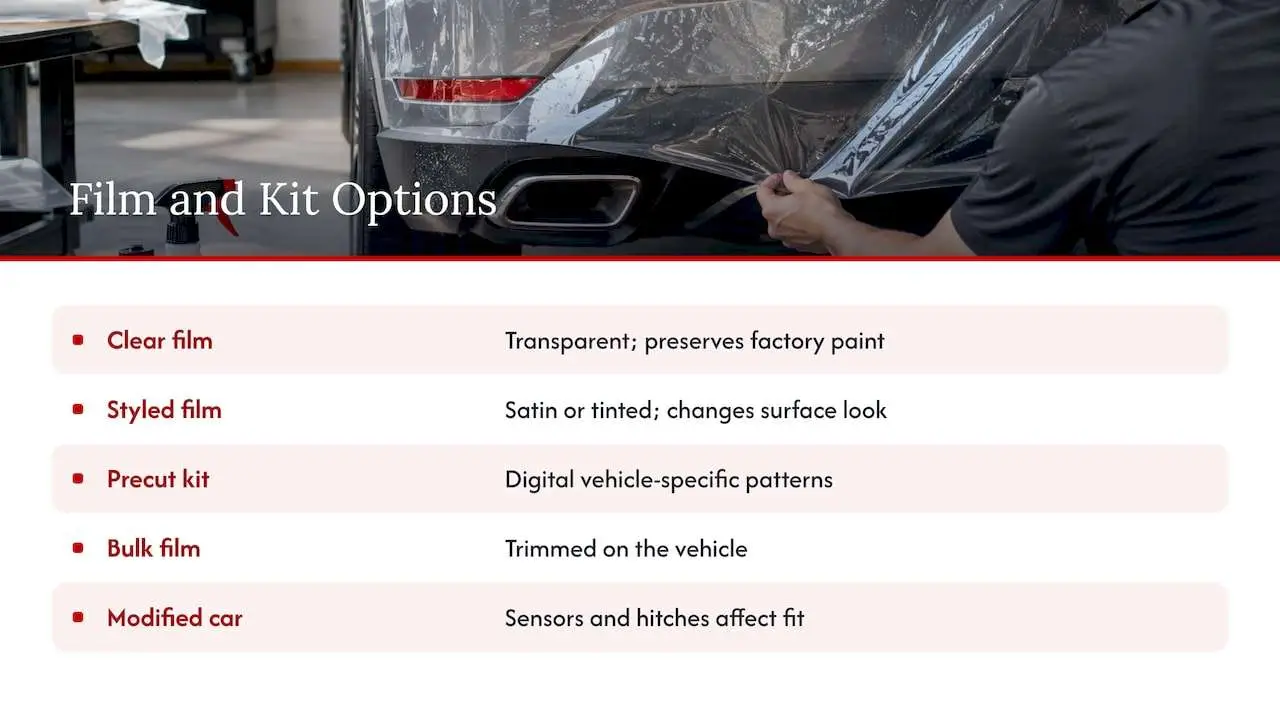
Clear film, styled film and precut kits
Clear film is transparent and helps preserve factory paint. Styled options, such as satin or tinted films, change how the surface looks, and if you want a look change instead of pure protection, that is a conversation about vinyl wraps or colored PPF rather than clear film.
Precut kits are another category you will see online. Vehicle-specific precut kits use digital patterns, while bulk film requires trimming on the vehicle. Precut patterns can fit well on many models, but they are designed around a stock car. Sensors, aftermarket parking aids, trailer hitches and license plate brackets all change what the film has to work around, and the installer’s judgment on edge placement matters.
At our shop, we choose the approach by vehicle, and edges are a priority: our installs are built around wrapped edges and clean alignment.
What it costs
We publish prices for our standard PPF packages and quote the rest to your specific car.
- Full Front PPF: $2,199 covers the front of the vehicle.
- Full Vehicle PPF: from $4,500, which includes the back of the car as part of a whole-car plan.
- Rear bumper coverage on its own or added to another package: this is a custom quote. Tell us your car, how you load it and how much of the rear you want covered, and we will price it.
The Full Front price covers the front of the car, so rear work is something we scope separately. If your goal is a consistent finish front to back, a Full Vehicle package is the simplest route. If you mainly want to protect the loading ledge on a daily driver, a smaller custom quote may be all you need.
We respond to quote requests the same day.
How a rear bumper install works
This is what happens in a professional install, and it shows why the details matter.
- Inspection. We look over the paint for chips, deep scratches and contamination, because film locks in what is under it.
- Decontamination and prep. The bumper and the panels around it are cleaned and dried. Proper preparation of adjacent panels is necessary, because dirt or debris can leach out from bumper seams or grille openings and contaminate the film during application.
- Film positioning. Slip solution goes on the film and the surface so the film can be moved into place, then positioned along the planned edge lines.
- Squeegee work. The installer pushes the solution toward the edges. Then a tack solution anchors the film while it is worked around curves and the edges are sealed.
- Cure. The film needs time to set before it meets water, covered below.
The process described by a film maker’s own guide follows this order: clean and dry, apply slip solution, position, squeegee toward the edges, anchor with tack solution, work curves, seal edges, then cure for 24 to 48 hours before water exposure. The same guide recommends a clean, sheltered space, preferably a garage, at +17°C to +23°C, which is roughly 63°F to 73°F. A controlled shop environment gives us that consistency regardless of whether it is a hot Valley afternoon or a cool morning.
Why the rear bumper rewards a professional
The usual problems on a first install are dirt contamination, overstretching, bubbles, wrinkles and lifting. Compound curves, recessed sections, openings and exposed edges are the difficult parts for first-time installers, and the rear of a modern car has all of them: parking sensors, reflectors, exhaust cutouts, license plate recesses and sharp corners where the bumper wraps toward the fenders.
Overstretched film thins and can lift later. A speck of dust trapped under a clear film is permanent until the film comes off. Because removal is also a skilled task, with professional removal recommended and steam used to keep the film pliable, getting the install right the first time saves a lot of trouble.
Is it worth it for your car?
Here is how we think about it by owner type.
- Daily drivers and SUV or crossover owners. If you load the trunk every day, the ledge takes the abuse, and a small amount of film there pays off the first time a bag of tools drags across it.
- Tesla owners. Clean, simple rear lines make scuffs show. Clear film keeps the finish uniform. Many Tesla owners pair rear coverage with a front package.
- Luxury and exotic owners. Resale value is the point. Factory paint across the whole rear, with no scratches on the loading ledge, is easier to sell.
- Enthusiasts. If you track the car or modify it, the rear coverage can be part of a larger plan, including our Track Pack on the PPF page.
If you are leasing, film can also help you hand the car back in clean condition, though check your lease terms for what counts as wear.
Caring for rear bumper PPF after install
The first 48 hours
XPEL’s guidance for its clear films is to wait 48 hours after installation before washing the car. For XPEL’s COLOR PPF, the guidance is 72 hours, while ULTIMATE PLUS, ULTIMATE FUSION and STEALTH are 48 hours. We tell every customer which film they have and when they can wash it. Also avoid slamming things against fresh edges and avoid picking at the film if you see a tiny haze or moisture pocket; those commonly clear as the film cures, and if something looks wrong, call us.
Long-term washing and maintenance
- Hand wash with a gentle, pH-neutral soap and clean microfiber.
- Keep pressure washers away from film edges, because they can lift the film. For COLOR PPF, XPEL also advises avoiding automatic tunnel washes.
- Rinse off bird droppings and bug residue promptly, since they can stain.
- Seal the film with XPEL Ceramic Boost at least once every six months.
- Be careful on the ledge itself: lift items in and out instead of dragging them, and keep sharp metal buckles from scraping across.
We laid out a simple routine in our PPF maintenance guide, and if you chose a ceramic coating as well, our page on washing a ceramic-coated car covers it.
How long it lasts
XPEL’s own support page says that while PPF is durable, its 5 to 10 year lifespan depends heavily on environmental exposure, driving habits and how consistently it is maintained. A rear bumper in LA sees plenty of sun and a lot of loading, so maintenance habits decide the outcome. We break down the factors in how long paint protection film lasts and our PPF lifespan guide.
Perspective
Most people come to us asking about the front bumper and hood, because that is where rock chips are obvious. Then they notice the rear ledge of their own car and realize it has quietly collected a year of scuffs.
Our view is simple: the rear is worth protecting, and it is worth protecting properly. That means planning where the film starts and stops, wrapping the edges so they do not catch and lift, and aligning the film cleanly around sensors and seams. A rear piece that looks stuck on is worse than one that is not there at all.
We use XPEL as an authorized installer, and we would rather talk through your car, how you load it and what you want it to look like than push a package. If you want the whole car done, Full Vehicle is the cleanest answer. If you want the ledge and upper bumper handled, we can quote that too.
Jake
Get rear coverage quoted for your car
If you are ready to protect the back of your car, we are an XPEL authorized PPF installer in North Hollywood. Full Front starts at $2,199 and Full Vehicle starts from $4,500, and rear bumper coverage is scoped to your car. Send us your make, model and how you use the trunk, and you will hear back the same day.
Look at our paint protection film options to see Full Vehicle, Partial Front and Track Pack, or learn more about the XPEL films we install. Prefer a one-stop visit? You can also add XPEL ceramic coating to the plan. Start from our home page to request your quote.
FAQ
Can I just put PPF on the rear bumper and nothing else?
Yes, a small rear job is possible, and we quote it to your car. That said, installers usually plan rear coverage across the bumper, trunk and nearby panels so edges land on natural lines and the film ages evenly. Tell us what you want to protect and we will suggest the cleanest edge placement.
How long before I can wash my car after rear bumper PPF?
For most XPEL clear films, wait 48 hours before washing. XPEL’s COLOR PPF needs 72 hours. After that, hand wash and keep pressure washers away from the edges. Ask us which film is on your car when you pick it up.
What is the difference between a bumper guard and PPF?
A guard is a stainless steel or ABS plastic piece that sits on top of the bumper, usually on the loading ledge. PPF is a clear film bonded to the paint that follows the panel shape and can extend beyond the ledge. Film is the choice for a factory look.
Does PPF stop all rear bumper damage?
No. It is designed to resist scuffs, abrasion, chips and staining on the covered surface, which is the daily damage most rear bumpers pick up. A hard impact can still dent or crack the bumper cover underneath. Good coverage and regular maintenance give you the best protection.
How much does rear bumper PPF cost in Los Angeles?
Our published packages are $2,199 for Full Front and from $4,500 for Full Vehicle. Rear bumper coverage is priced as a custom quote based on your vehicle and how much of the rear you want covered. Send your details and we respond the same day.
Sources
- How to Wrap Bumper with PPF, Teckwrap
- Precut Paint Protection Film Kits
- Paint Protection Film Installation Guide, Legend PPF
- XPEL Product Care Instructions
- XPEL Product Care, Australia
- XPEL Product Care, India
- XPEL Support FAQs