
For most drivers, a film in the mid-range thickness commonly used delivers the best balance of chip resistance and clean installation. Thinner films around 6 to 6.5 mil install easier but sacrifice impact absorption; anything above 8.5 mil gets noticeably harder to lay down on curves. Off-roaders and exotic car owners often push to 10 mil on high-impact zones, but full-vehicle coverage at that thickness isn’t necessary for a typical commute.
TL;DR:
- Films between 7.5 and 8.5 mil generally provide optimal impact resistance for most drivers, with 8 mil offering a balanced option for daily use.
- Thicker films, like 10 mil, significantly improve impact absorption but are harder to install on curved panels and are mainly suited for high-impact zones.
- Impact protection increases nonlinearly as thickness grows, with each additional mil delivering disproportionately better resistance based on drop-ball tests.
- Thickness alone does not determine durability; topcoat quality, TPU grade, and adhesive formulation are equally crucial for long-term performance.
- Proper installation and zone-based coverage, combined with informed shop questions, are key factors for effective, long-lasting paint protection.
Table of Contents
- PPF Thickness and How to Read Mil Ratings
- How Thickness Affects Real-World Impact Protection
- Installation Trade-Offs: Why Thicker Isn’t Always Better
- Practical Thickness Recommendations by Use Case
- The Installer Checklist: What to Ask Before You Book
- Thickness Isn’t the Whole Story: Topcoat, TPU Grade, and Warranty
- How Long PPF Actually Lasts
- Real-World Notes From PPF Pros: What Installers Actually Choose
- Common Commercial Thickness Tiers Explained
- Measurement Tolerance and Quality Testing Standards
- Balancing Protection and Appearance: An Editorial Takeaway
- Get an XPEL PPF Quote Built Around Your Driving Pattern
- Sources
PPF Thickness and How to Read Mil Ratings
A “mil” is one-thousandth of an inch, or roughly 25.4 microns. When a product listing says “8 mil PPF,” it means the total film stack measures 0.008 inches thick, edge to edge. That number on a spec sheet is a bundle, not a single material.
Every roll of paint protection film stacks several distinct layers together, and the mil rating you see is the sum of all of them:
- Topcoat — the outermost layer, responsible for gloss, self-healing, and scratch resistance
- TPU base (core) — the thermoplastic polyurethane layer that actually absorbs impact energy
- Adhesive — the layer that bonds the film to your car’s paint
- Release liner — a temporary protective backing removed during installation and not counted in the final mil rating
A 3M technical data sheet for its Scotchgard PPF Pro Series shows how granular this gets in practice: the cap sheet measures around 1.0 mil, the film-plus-adhesive layer comes in around 7.8 mil, and the liner adds roughly 3.0 mil on top, though the liner peels away before the film ever touches your paint. Manufacturing tolerances typically run a few tenths of a mil in either direction, which is normal and expected across a production batch.
Here’s the part that catches a lot of buyers off guard: two films can carry the identical “8 mil” label on the box and perform completely differently in a rock strike. If one has a thick topcoat and thin TPU core, and the other reverses that ratio, the second film will absorb impact energy far better even though the total number matches. That’s why asking for the TPU core breakdown matters more than asking for the total mil alone. Understanding this layer structure also clarifies the difference discussed in clear bra versus PPF comparisons, since “clear bra” is really just an older name for the same layered film technology.
How Thickness Affects Real-World Impact Protection
Thicker TPU cores don’t just add marginal protection. They add it at an accelerating rate, and the gap between tiers is bigger than most people expect.
Controlled drop-ball testing from KSB Window Film’s technical comparison illustrates the pattern well. Measured against an unprotected painted panel in that specific test setup, directional improvements in impact resistance looked roughly like this:
- 6.5 mil film: approximately 73% better impact resistance than bare paint
- 7.5 mil film: approximately 118% better
- 8.5 mil film: approximately 167% better
- 10 mil film: approximately 229% better
These are comparative, test-specific figures, not universal guarantees. Drop-ball and H50-style tests vary by lab, drop height, projectile size, and substrate, so treat the trend, not the exact percentages, as the takeaway. Different manufacturers run different rigs, and a film that tests well in one lab’s setup won’t necessarily produce identical numbers in another’s.
The pattern still holds across sources: going from 6.5 to 7.5 mil buys you more protection than the 1 mil difference suggests, because TPU absorbs and disperses kinetic energy nonlinearly rather than in a straight line. Push to 8.5 mil and the gains keep compounding. That’s the physics case for upgrading a tier on high-exposure panels, even though the jump from 6.5 to 10 mil doesn’t triple your protection, it roughly triples your impact resistance in this specific comparative test, which is a meaningfully different (and more useful) way to think about the number.
What this means practically: a rock chip that would penetrate a 6.5 mil film’s topcoat and dent the clear coat underneath might just leave a shallow mark on the same film’s 8.5 mil cousin, because the extra TPU flexes and disperses the strike instead of transmitting it straight to the paint.
Installation Trade-Offs: Why Thicker Isn’t Always Better
Every added mil of TPU makes the film stiffer and harder to stretch around curves. That’s the honest trade-off nobody puts on the marketing page.
Thicker films need more heat and more tension to conform to compound curves, tight body lines, and sculpted bumper cutouts. Push a rigid film too far past its stretch limit and you get problems that show up months later, not on install day.
Watch for these installation risks when a shop uses film that’s too thick for the panel geometry:
- Tension lines — visible stress marks where the film was stretched beyond its comfortable range
- Edge lift — corners and edges that start peeling because the adhesive couldn’t hold under sustained tension
- Distortion on tight radii — a slightly hazy or rippled look around mirrors, door handles, and sculpted vents
- Uneven gloss — patches where heat application was inconsistent trying to force conformability
Experienced installers solve this with a zone strategy rather than one uniform thickness across the whole car. Thicker film goes on the hood, front bumper, and mirror caps, where impact risk is highest and the panels are flatter. Thinner, more pliable film covers mirrors, door cups, and deeply sculpted trim where flexibility matters more than raw thickness. On complex modern bumpers with aggressive contours, shops frequently pre-cut with software templates and plan relief cuts and heated tucks specifically to manage tension in thicker film.
Pro Tip: If you’re reviewing a finished install and see faint white lines or a slight ripple near a curved edge, that’s usually a sign the shop tried to force film that was too thick onto a radius it wasn’t built for.

Practical Thickness Recommendations by Use Case
Your driving pattern should drive the thickness decision more than brand loyalty or what a forum thread said last year.
- Daily driver / city use: 7.5 mil covers most commuting scenarios well, balancing chip resistance against curbs, parking lots, and stop-and-go traffic with a film that installs cleanly on every panel.
- Highway / high-speed commuting: bump the front bumper, hood, and mirrors to 8 to 8.5 mil. Highway speeds throw debris harder, and the front-end zones take the brunt of it.
- Off-road / rural driving: gravel roads and loose debris call for 9.5 to 10 mil, sometimes heavier, on the front end and rocker panels where kicked-up stones hit hardest.
- Luxury and exotic cars: finish quality usually outranks maximum thickness here. Many owners land on 7.5 mil with a high-grade TPU and topcoat, prioritizing a flawless, invisible install over chasing the highest number on the spec sheet.
- Fleet and leased vehicles: thinner, cost-effective options with a planned replacement cycle make more financial sense than premium film on a vehicle you won’t own long-term.
None of these are rigid rules. A driver splitting time between highway commuting and weekend off-road trips might reasonably run 8.5 mil everywhere and skip the mixed-zone approach entirely for simplicity.
The Installer Checklist: What to Ask Before You Book
A good shop will answer every one of these without hesitation. A shop that gets vague deserves a second look before you hand over a deposit.
- Ask for the total mil and the TPU core breakdown separately, and request the product’s technical data sheet rather than taking a verbal number.
- Ask which panels get thicker film and why. A shop using a genuine zone strategy should be able to explain its reasoning panel by panel, not just quote one thickness for the whole car.
- Confirm warranty terms in writing, specifically what’s covered for yellowing, delamination, and edge lift, and for how many years.
- Ask to see photos of similar past installs on a comparable vehicle, plus the shop’s policy if a panel needs repair or a redo.
- Ask how they verify installed thickness, whether that’s a micrometer check on sample material or a visual inspection against the TDS tolerance range.
Any installer who can’t speak to at least the TPU core question is likely selling on total mil alone, which, as covered above, tells you less than it seems to.
Thickness Isn’t the Whole Story: Topcoat, TPU Grade, and Warranty
A thick film with cheap chemistry will still disappoint you. Thickness measures how much material is there; it says nothing about what that material is made of.
- Topcoat chemistry drives self-healing and stain resistance, and that performance is chemistry-dependent, not thickness-dependent. A thin film with a strong UV-stabilized topcoat can outperform a thick film with a weak one when it comes to yellowing resistance.
- TPU grade and polymer supplier matter as much as raw core thickness. Not all TPU is created equal, and premium suppliers formulate for better elasticity recovery after minor scuffs.
- Adhesive formulation determines how well the film bonds long-term and directly affects edge lift risk, independent of how thick the film sits above it.
- Warranty length and terms are one of the more reliable signals a manufacturer has confidence in its own material and application process. A short or vague warranty is worth questioning regardless of the mil number on the label.
Think of thickness as one input variable in a formula, not the whole formula.
How Long PPF Actually Lasts
Realistic expectations save you from disappointment three years in. Premium TPU film, properly installed and maintained, commonly lasts 7 to 12 years. Mid-range TPU films typically run 5 to 8 years before yellowing, edge lift, or haze become noticeable.
Climate accelerates the timeline. High-UV regions and cars parked outdoors year-round will see the lower end of any range, while garaged vehicles in milder climates often reach the upper end.
Basic maintenance stretches that lifespan:
- Hand wash or touchless wash only; avoid brushes and harsh solvents that degrade the topcoat
- Use warm water or a heat gun on light scuffs to trigger the self-healing topcoat
- Address edge lift immediately rather than letting moisture creep underneath
A single lifted corner or a cracked section usually calls for a panel repair, not a full re-wrap, unless the damage has spread across multiple zones.
Real-World Notes From PPF Pros: What Installers Actually Choose
Working the shop floor gives you a different read on thickness than any spec sheet does. Most commuters who come through our North Hollywood shop land on 7.5 to 8.5 mil for front-end coverage, that’s the range that consistently balances chip protection against a clean, invisible finish on daily drivers. Owners who mention regular trips on gravel roads or unpaved terrain tend to move up to 10 mil on the front bumper and rockers specifically, not the whole car.
Mixed-thickness zone strategy isn’t a marketing line, it’s standard practice: thicker film on flat, high-impact panels, more pliable film around mirrors and sculpted trim. If you’re booking an install, come with clean paint and a rough sense of your driving pattern, it speeds up the thickness conversation considerably.
Common Commercial Thickness Tiers Explained
Walk into any PPF conversation and you’ll hear the same four numbers repeated: 6.5, 7.5, 8.5, and 10 mil. These aren’t arbitrary marketing tiers, they’ve become the industry’s practical shorthand because they map to real trade-off points between flexibility and protection.
The 6.5 mil tier sits at the lighter end of what’s commercially sold as PPF, and you’ll mostly see it marketed toward budget-conscious buyers or specific low-exposure trim pieces rather than full front-end coverage. It’s the easiest tier to install on tight curves.
The 7.5 mil tier has become something of a default recommendation across the industry, and for good reason: general guidance from film manufacturers consistently lands here as the balanced middle ground for daily-use vehicles.
The 8.5 mil tier steps up meaningfully in impact resistance while still being workable for most installers on standard body panels, making it the common upgrade choice for highway-heavy drivers.
The 10 mil tier represents the thickest commercially available range, roughly 254 microns, and it’s reserved almost exclusively for high-impact zones on off-road vehicles or as a front-end upgrade on cars that see serious debris exposure. Very few shops recommend it across an entire vehicle because the installation difficulty on curved panels climbs sharply at this thickness.

Between these four tiers, most vehicle owners find their answer sits closer to the middle than either extreme.
Measurement Tolerance and Quality Testing Standards
Every mil number on a spec sheet carries an implicit tolerance range, and knowing that range helps you separate a legitimate quality variance from a genuinely mislabeled product.
Manufacturing tolerances for automotive PPF typically run a few tenths of a mil above or below the stated number, a normal byproduct of the extrusion process that produces TPU film in continuous rolls. A film labeled 8 mil might measure anywhere from roughly 7.7 to 8.3 mil across a given batch and still fall well within acceptable production standards.
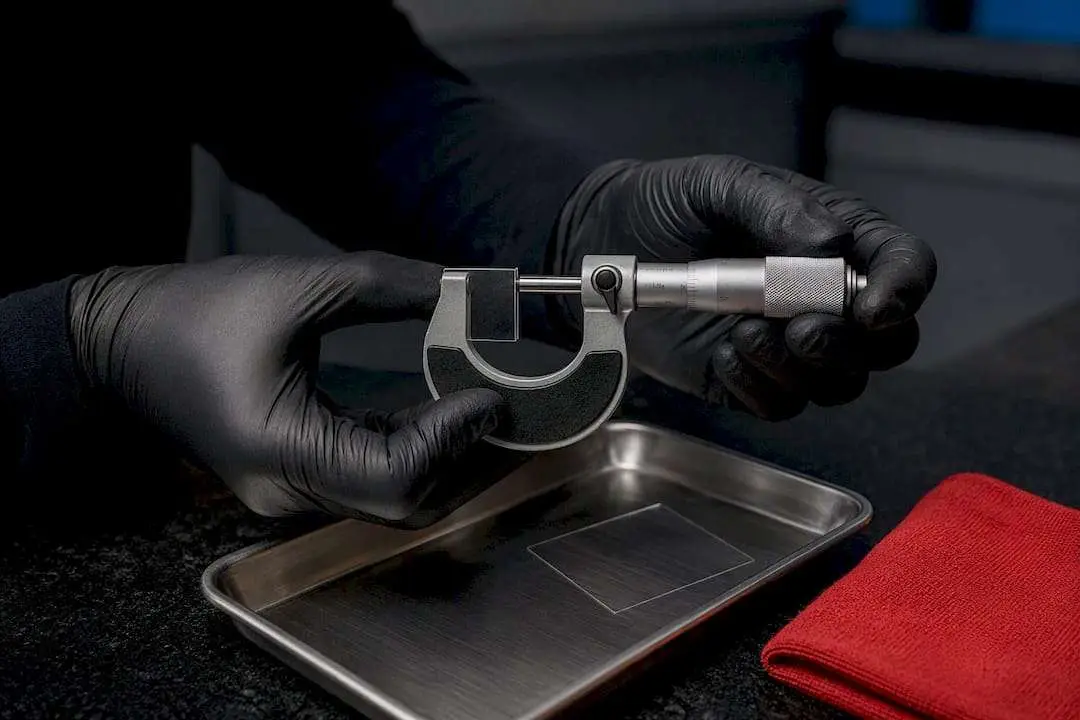
Quality verification in the field usually happens two ways. Installers with a micrometer can spot-check sample material against the manufacturer’s stated tolerance before it goes on the car, which is the more rigorous method. Visual inspection, checking for consistent clarity, no bubbling, and uniform gloss across the panel, catches most practical defects even without specialized equipment.
For the underlying test methodologies that govern how film thickness, adhesion, and optical clarity get measured industry-wide, ASTM International maintains the standards referenced across the film and coatings trade, including procedures relevant to automotive protective films. SEMA-affiliated trade discussions also reference these standards when addressing quality benchmarks for the broader vehicle customization industry. If a manufacturer can’t point to a TDS with clear tolerance language, that’s worth asking about directly before committing to a purchase.
Balancing Protection and Appearance: An Editorial Takeaway
Chasing the highest mil number on the shelf is the wrong instinct. Zone-based upgrades, thicker film where impact risk is real, lighter film where curves demand it, consistently outperform blanket heavy-thickness coverage for how most people actually drive.
Installer skill and TPU core quality decide outcomes more than the number printed on the box. Before booking anything, run the shop through the checklist above. A confident answer to every question there tells you more than any spec sheet will.
— Jake
Get an XPEL PPF Quote Built Around Your Driving Pattern
Some installers walk you through zone-specific coverage, thicker film where your car actually takes hits, lighter film where the curves demand it, instead of selling one blanket thickness for the whole vehicle.
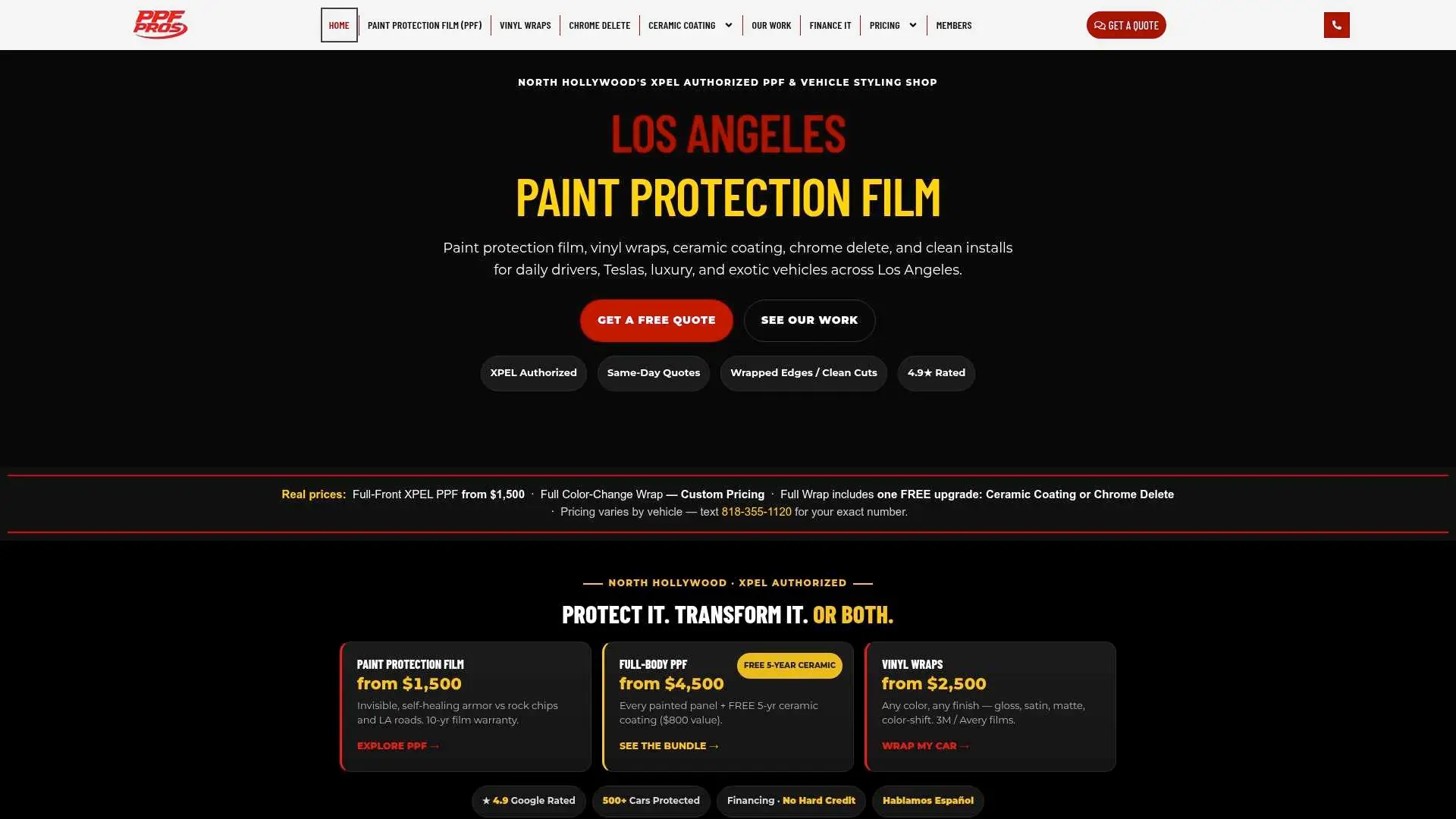
Some shops offer full-vehicle and zone-specific PPF installs, along with vinyl wraps, ceramic coatings, and chrome deletes for daily drivers, Teslas, and exotic cars. Precision installs may earn high customer ratings, and some quotes are built around individual driving patterns rather than generic packages. If you’re weighing thickness options for your own car, request a full-front PPF quote and we’ll walk you through the right zone strategy for your panels. Curious about pairing protection with long-term shine? Our PPF and ceramic coating bundle covers both in one visit.
Sources
- PPF Thickness, Durability and Performance — KSB Window Film
- PPF Thickness Explained: Mil Ratings, Durability, Installation & Best Thickness Guide — GlobalHiTech Films