Dirt along the edge of paint protection film (PPF) is one of the most common things owners notice after a few months. Most of the time it is a thin line of road grime, wax or dust sitting against the film’s edge, and it can be cleaned safely. Sometimes it is a sign that the edge has started to lift, and then cleaning harder makes it worse. This guide helps you tell the two apart, shows what you can do at home, and explains when to bring the car back to the shop.
TL;DR
- A visible line of dirt at a PPF edge is usually surface grime or wax buildup. It is often cosmetic and can be washed off gently by hand.
- Edges that were not wrapped or tucked collect more dirt over time, and a lifted edge collects it fastest. Check whether the edge is flat before you scrub.
- Keep pressure washers away from edges, skip abrasive pads and harsh chemicals, and never pick at a corner with a fingernail or blade.
- If the edge is lifting, curling, or the dirt is underneath the film, stop and contact your installer. Replacement is a manufacturer remedy for defects, not a fix for every dirt line.
Table of Contents
- Why dirt collects at PPF edges
- Dirt line or lifting edge: how to tell
- How to clean dirt off a PPF edge yourself
- The first weeks matter most
- Our perspective on edge dirt
- When to see your installer
- Can mold grow under PPF?
- How to prevent edge dirt on your next install
- Get your PPF edges checked or installed right
- FAQ
- Sources
Why dirt collects at PPF edges
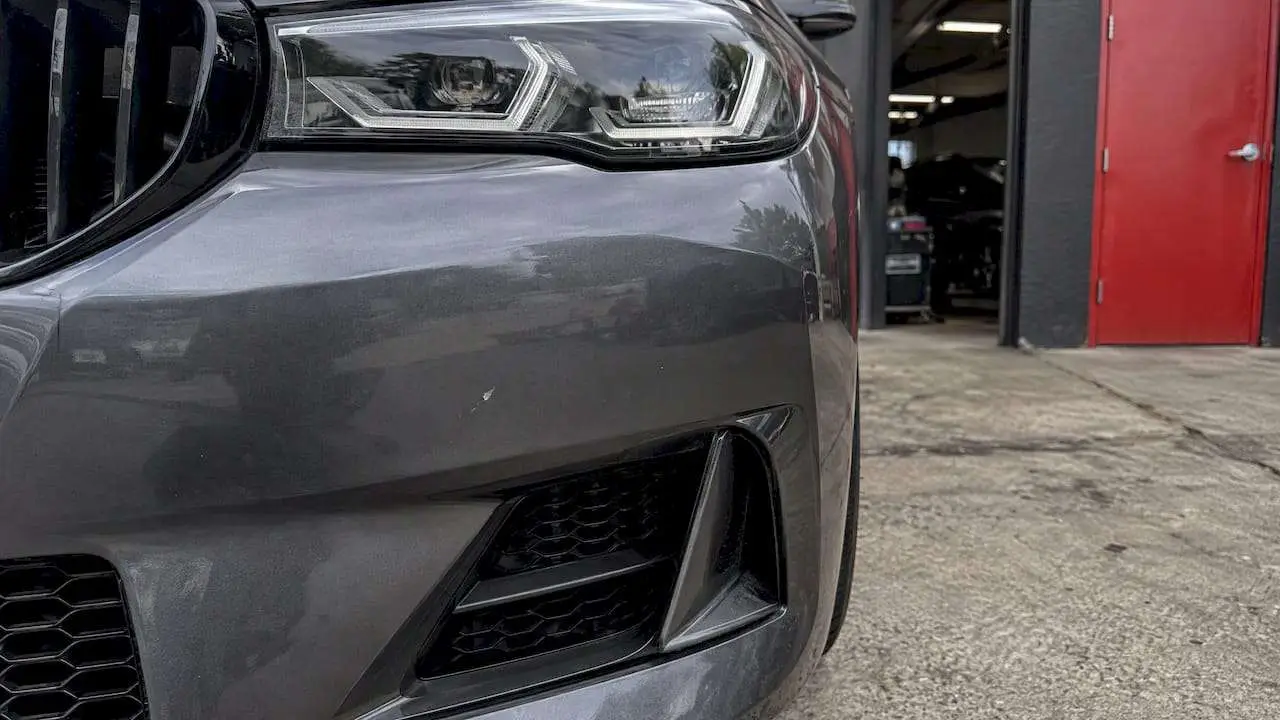
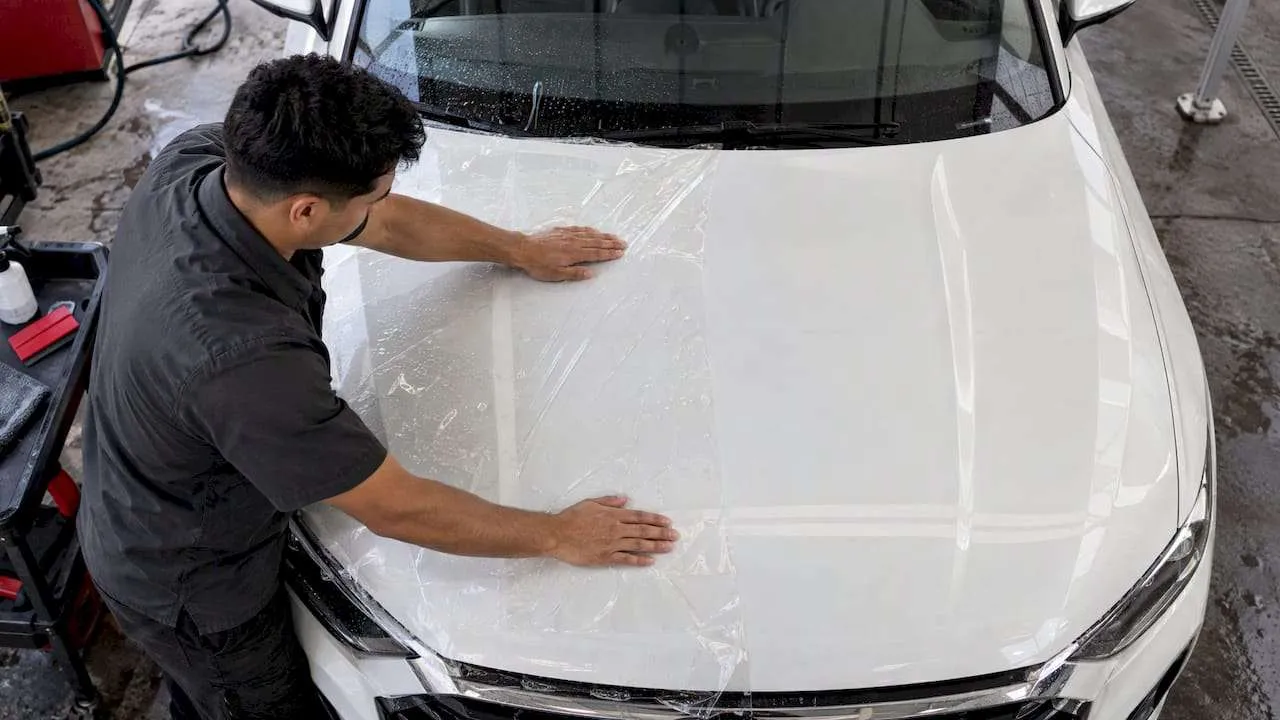
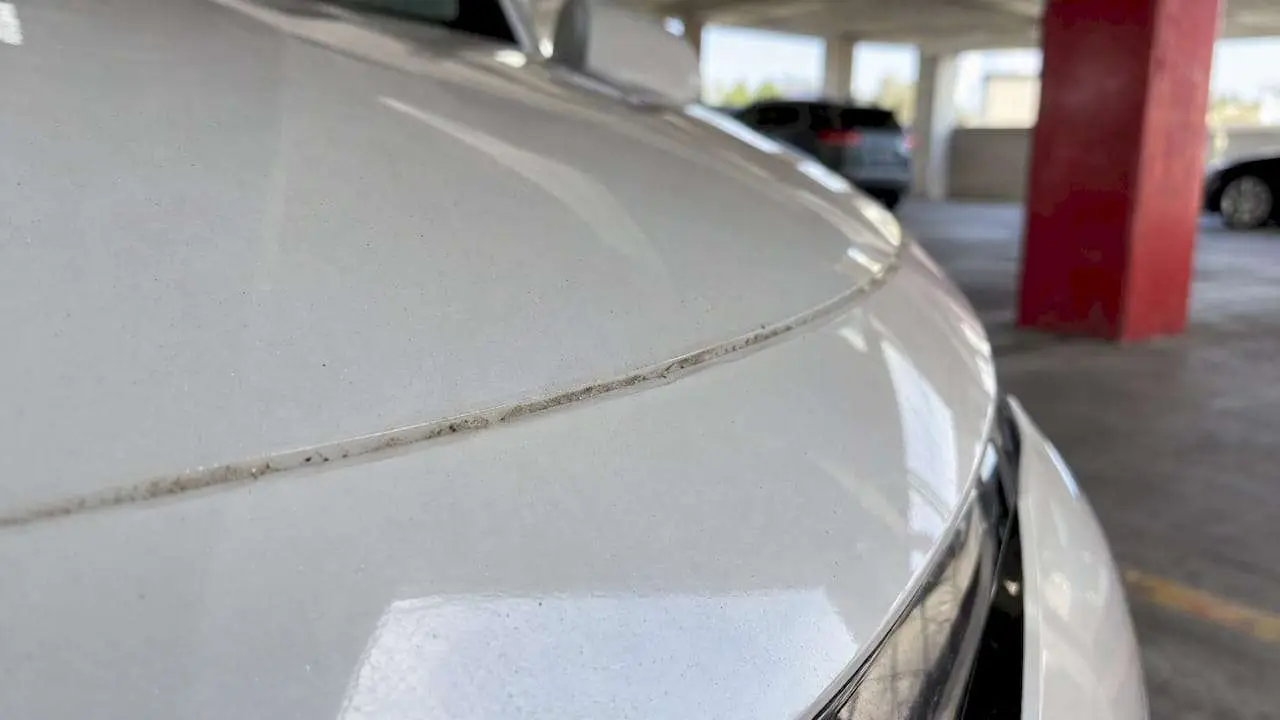
PPF is a thin urethane film with an adhesive layer. Wherever the film stops, there is a tiny step between the film and the paint. Dirt, wax, polish residue and water naturally settle into that step. On a light-colored car it shows as a gray or tan outline. On a dark car you may only notice it in sunlight.
There are four common reasons the line gets worse.
The edge could not be wrapped
A good installer wraps film around panel edges and tucks it where the panel allows. In some spots that is not possible, such as flat areas where a pattern is cut to stop short of a seam, a trim piece or a sensor. Those exposed edges are where grime builds first. It is a characteristic of the film in those areas rather than automatically a defect, and it is more visible on some paint colors than others.
Contamination was left on the paint
Adhesion depends on the paint underneath. Avery Dennison’s installation bulletin says clean, smooth, dry paint is critical for adhesion, and that dirt, grease, oil, wax, polish and trapped water must be removed, with special attention to edges, corners and panel returns. If a speck is trapped at the edge during installation, it can open a channel that later pulls in more dirt. This is why we begin every job with an inspection and a decontamination wash before film touches the paint.
Washing habits push water into the edge
3M states that excessive pressure can force water beneath PPF, weaken adhesion and cause lifting or curling. Automated brush washes and a close pressure-washer nozzle are the usual culprits. Once the edge lifts even a fraction of a millimeter, it traps dirt and the line grows.
Time, sun and heat
Film and adhesive age, and Los Angeles gives them plenty of sun, dust and freeway debris. XPEL notes that how often a car needs maintenance depends on mileage, storage, driving style, climate and road conditions. A garaged weekend car and a daily commuter on the 101 will not show the same edges after a year.
Dirt line or lifting edge: how to tell
Before you clean anything, spend two minutes looking. Wash and dry the panel first, then check in daylight.
| What you see | Likely cause | What to do |
|---|---|---|
| Thin gray or tan outline, edge lies flat | Surface grime or wax at the film step | Gentle hand wash and soft cleaning, see below |
| White waxy crust along the edge | Wax or sealant buildup | Remove carefully with a soft detailing cloth |
| Edge looks raised, corner curls, or dirt is visibly under the film | Lifting adhesion | Do not scrub. Contact your installer |
| Cloudy or discolored patch spreading from the edge | Moisture under the film | Have it inspected promptly |
| Dirt only along a long straight cut across a flat panel | Exposed edge that could not be tucked | Cosmetic, keep it clean on a schedule |
A simple test: look along the edge at a low angle. If light shows a gap or the film edge appears to stand off the paint, treat it as lifting. If the edge is flush and the dirt sits on top, it is surface grime.
How to clean dirt off a PPF edge yourself
If the edge is flat and well bonded, a careful hand wash will remove most lines. The approach across the film makers is consistent: gentle, cool, no pressure.
- Wait until the car is cool and in shade. XPEL recommends hand washing out of direct sunlight after the vehicle has cooled, then drying with an electric blower or a plush microfiber towel.
- Rinse first. Avery Dennison’s maintenance bulletin recommends rinsing before cleaning and gentle manual washing with a compatible cleaner and a lint-free microfiber cloth. It also advises against abrasive tools, high-pressure water and steam cleaning.
- Use a quality car shampoo and a clean mitt. 3M recommends a commercial shampoo for routine cleaning.
- Work along the edge, not into it. A forum tip that holds up: always move from behind the edge and past it, so the cloth never catches the film’s lip and pushes it up.
- Dry thoroughly. Blow water out of edges and corners so nothing sits in the step.
For wax buildup, a detailing cloth, a soft brush or a cotton swab can clear residue from the edge, as 3M’s care guidance describes. Use light strokes and let the swab do the work.
What about alcohol?
This is where advice conflicts, and it is worth being careful. 3M says to avoid strong alkaline, acidic or alcoholic cleaning agents because they may permanently damage PPF. Profilm, on the other hand, says edge dirt buildup can be removed with alcohol and a lint-free cloth. XPEL allows 99% isopropyl alcohol on stubborn surface stains, but only while keeping the chemical off the paint.
Those instructions are written for different films and different situations, and none of them says to flood a lifted edge. Our advice: do not use alcohol on your own unless you know which film is on the car and what that maker allows. Alcohol can also seep under an edge that is not fully bonded. If a wash does not remove the line, ask us before escalating.
What to avoid
- Pressure washers up close. 3M’s limits are a minimum 40-degree spray, a maximum of 80 bar, water no hotter than 140°F (60°C), and at least 30 cm from the film, and it advises not aiming the stream at an edge from 0° to 60°. Profilm suggests keeping the nozzle at least 1 meter from edges with a wide spray. The easy rule: if you wonder whether you are too close, you are.
- Automatic brush washes. 3M Malaysia notes that automated washes may lift edges.
- Abrasive polishes, rubbing compounds and dye-containing waxes. 3M says these can damage the film surface.
- Unapproved solvents and abrasives. XPEL specifically says not to use them.
- Fingernails, razor blades and plastic cards. Picking at a dirty corner is the fastest way to turn a cosmetic line into a lifted edge.
The first weeks matter most
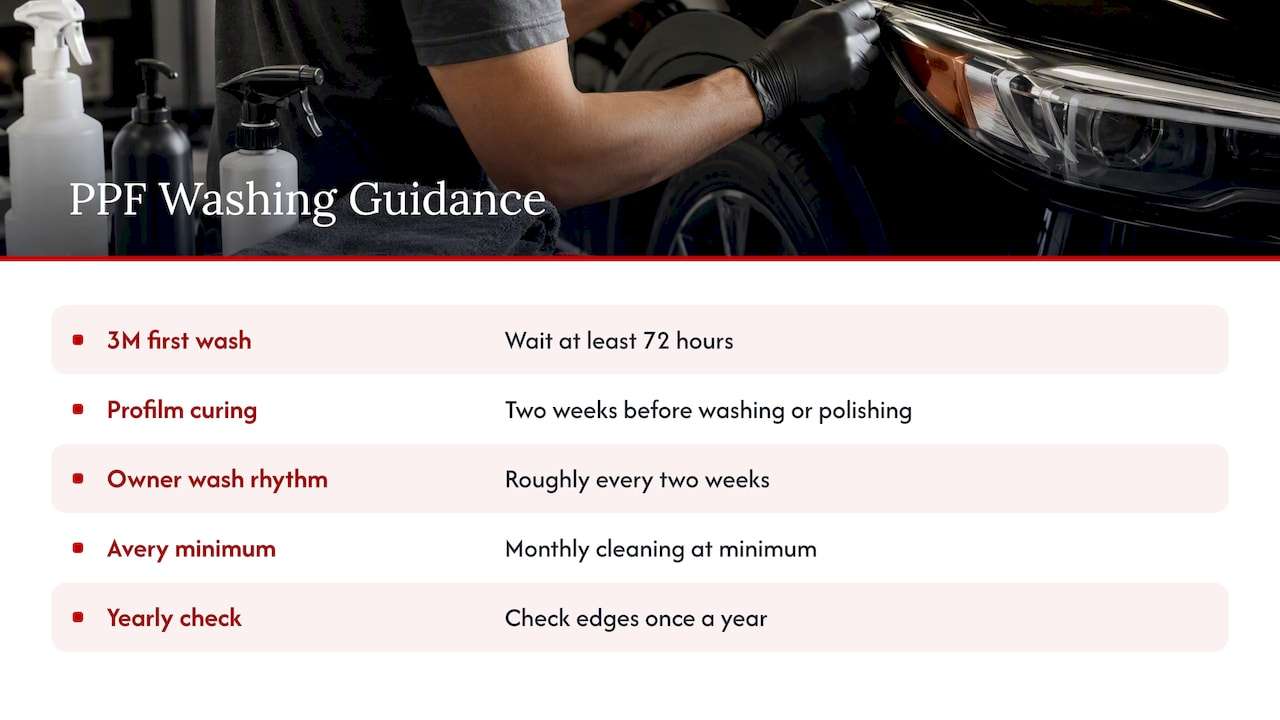
Fresh film needs time to bond. 3M’s guideline says to wait at least 72 hours before washing after installation and prefers touchless or hand washing, then to check for edge lifting after the wash. Profilm recommends a two-week curing period before washing or polishing. Rules differ between films, so follow the instructions you were given for your specific product. If your car has recently been done, hold off on edge cleaning and just keep the car out of automated washes.
Later, the best protection against edge lines is routine. Our PPF maintenance guide lays out a rhythm for busy owners, with a wash roughly every two weeks and a yearly check. That lines up with Avery Dennison’s advice of monthly cleaning at minimum and prompt removal of heavy contaminants such as bird droppings and bugs.
Our perspective on edge dirt
We see edge dirt on cars that come in for a yearly check, and the pattern is predictable. Most lines are not a failure of the film. They are a wash routine problem, a wax problem, or an exposed edge on a light-colored panel that simply needs to be kept clean.
What we look at is how the edge was finished. Wrapped edges and clean alignment are the point of a precise installation, because an edge that is tucked has nothing for dirt to catch on. Where a panel does not allow a wrap, we plan the cut line so it falls somewhere discreet and tell you up front where you may see a line. We would rather you know that before the car leaves than discover it in a month.
We also tell owners honestly when something is not a dirt problem. A raised corner, a spreading haze, or dirt visible beneath the film belongs in the shop, not in a driveway with a bottle of solvent. Quick attention often means a small fix instead of a large one.
One more thing we say a lot: edges are not the only thing to judge. If you are comparing texture across a panel, our guide on checking PPF orange peel against an unwrapped panel shows how to separate normal film texture from real installation flaws.
— Jake
When to see your installer
Bring the car in if you notice any of the following:
- The edge or a corner is visibly raised, curling or peeling.
- Dirt or moisture appears to be underneath the film, not on top of it.
- A dirt line comes back within days of a clean wash.
- A hazy or cloudy patch spreads from an edge.
- You bought a car that already has PPF and the edges are dark, stained or discolored.
XPEL tells owners to contact an authorized dealer if any damage occurs, however small, and recommends a yearly inspection with an authorized dealer. 3M’s guideline says that after washing you should check for edge lifting and have damaged film repaired, removed or replaced.
What a repair can look like
Options depend on how far the problem has gone. A shop can clean contamination, gently polish the film surface, re-seat an edge that is lifting slightly, replace a single piece of film, or redo a panel. Profilm’s guidance, for instance, is to return the vehicle to the installation center for a gentle polish if dirt gathers on the film over time or in extreme conditions. Which option fits depends on the film, the age of the install and the cause, which is why we look at the car first.
Does the warranty cover edge dirt?
Not automatically. XPEL’s Ultimate Plus Black warranty document covers professionally installed film defects such as cracking, blistering, delamination and discoloration for 10 years, subject to exclusions, with removal or replacement as the remedy for covered manufacturing defects. A dirt line from wash habits, or a lift caused by pressure washing, is not the same thing as a manufacturing defect. Read the warranty terms for your film and ask your installer how a workmanship issue would be handled before you book.
Can mold grow under PPF?
It is a question people ask, and it is a fair one when you see a dark or cloudy patch near an edge. Moisture trapped under a lifted edge, together with dirt, is the kind of condition where discoloration appears. We would not diagnose it from a photo, and you should not try to flush it out. The US EPA’s guidance on mold says remediation starts by assessing the extent of the problem and any continuing moisture problem. For a car, that translates to getting a professional to inspect the film and the paint underneath, then deciding whether the section needs to be redone.
How to prevent edge dirt on your next install
Most of the prevention happens before the film goes on.
- Ask where edges will fall. A good installer can show you which edges are wrapped and which end at a seam or trim.
- Choose the right coverage. Larger panels wrapped fully have fewer exposed edges than a partial cut. Our Full Front package covers the areas that take the most abuse and is priced at $2,199, while Full Vehicle coverage starts from $4,500 on our PPF services page.
- Insist on paint preparation. Contamination left on the paint is a cause of edge trouble later.
- Follow the cure time. No washing or automated washes in the first days, per your film’s instructions.
- Stick to a wash schedule. A clean edge never gets a chance to build a line.
Get your PPF edges checked or installed right
If your film has dirty edges and you are not sure whether they are cosmetic or lifting, bring the car to our North Hollywood shop. As an XPEL authorized installer, we inspect the film, tell you plainly what we see, and quote any fix before work begins. If you are planning new film, we wrap edges and align panels with care so there is less for dirt to catch on. See our Los Angeles PPF page to request a quote. We respond the same day.
FAQ
How do I get dirt out from under PPF?
If the dirt is on top of the film at the edge, a gentle hand wash and a soft cloth or cotton swab will usually remove it. If it is truly under the film, the edge has lifted, and it should not be flushed or scrubbed at home. Contact your installer, who can decide whether the edge can be re-seated or the piece needs replacing.
Should PPF be waxed?
It can be, but use products the film maker approves, because 3M warns that dye-containing waxes and abrasive polishes can damage the film. Wax tends to build up along edges, so apply it thinly and clear any residue from the edge with a soft detailing cloth. Ask your installer which products suit your film.
Will water bubbles in PPF go away?
Small water pockets from a fresh installation often clear as the film cures, which is why makers ask you to wait before washing or polishing. Do not press or poke them. If they are still there after the cure period you were given, or if they sit at an edge, have the installer look at them.
Can mold grow under PPF?
Moisture trapped beneath a lifted edge can lead to dark or cloudy discoloration, and the EPA notes that any mold response begins with assessing moisture. Do not try to flush it out. Have a professional inspect the film and paint, since the section may need to be removed and redone.
Is dirt at the edge a sign the installation is bad?
Not necessarily. Exposed edges on panels that cannot be wrapped naturally collect grime, and it is more visible on some colors. A bad installation shows up as lifting, peeling corners, trapped debris under the film or edges that return dirty right after washing. If you are unsure, an in-person inspection settles it quickly.
Sources
- 3M Paint Protection Film Installation Guideline
- 3M PPF Care guidance
- Avery Dennison IB4.40 Dry Apply PPF Guidelines
- Avery Dennison TB 6.20 Maintenance Instructions
- XPEL Product Care Instructions
- XPEL Ultimate Plus Black warranty document
- Profilm PPF Care and Warranty
- Profilm care and maintenance guide
- US EPA Mold Course Chapter 4