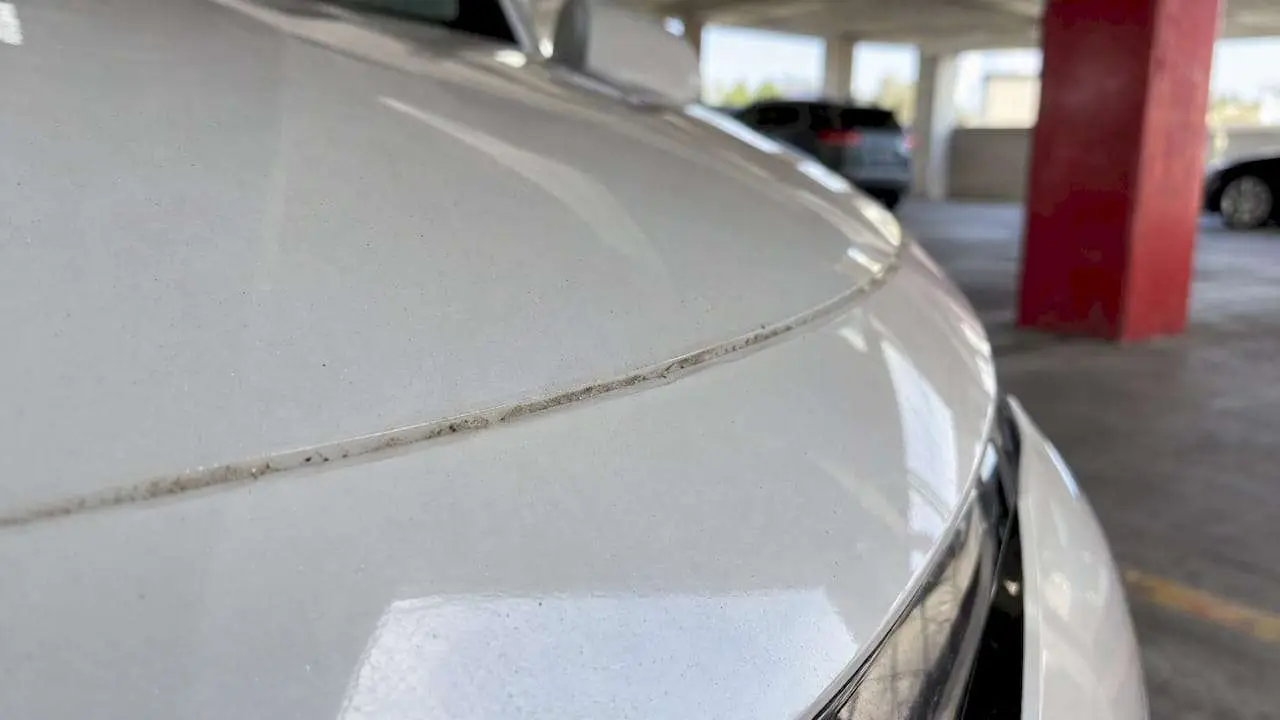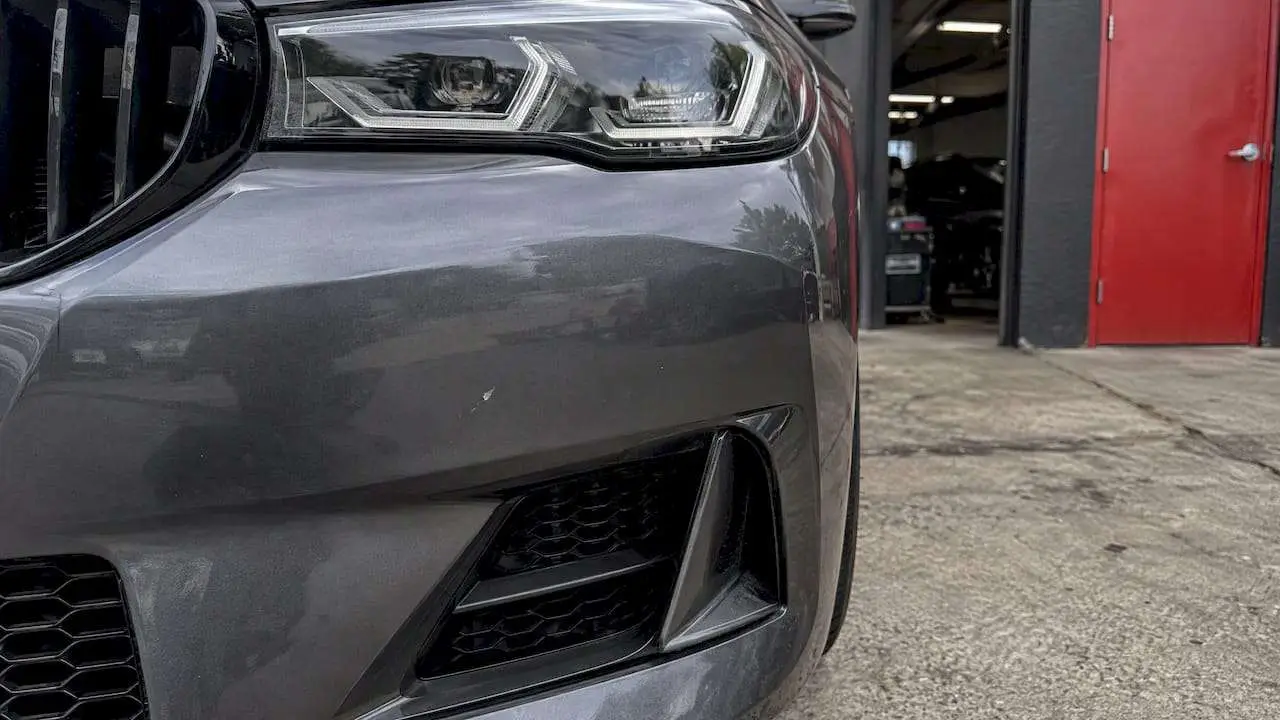
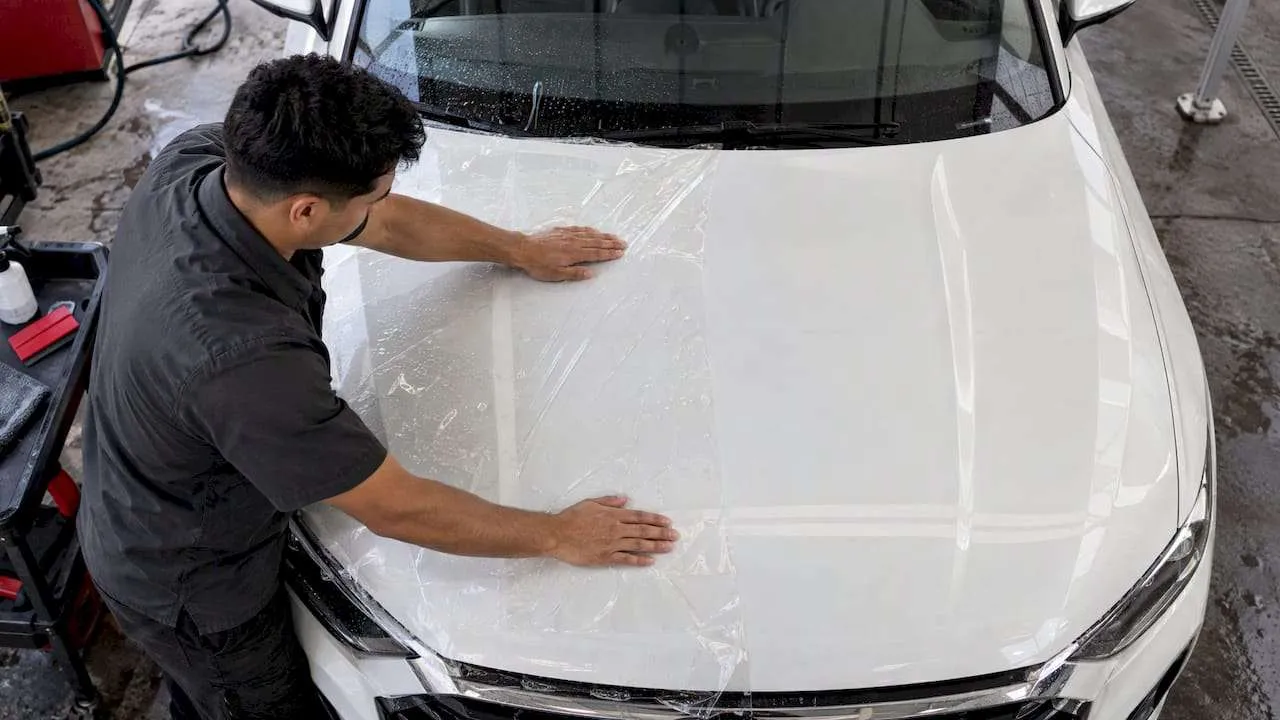
Yes, paint protection film makes sense on a white car, and white is the color where the quality of the film matters most. White paint shows rock chips, tar and road film in ways other colors hide, and it also exposes a weak film faster, because any tint or dull edge shows against a bright panel. Choose a quality clear film, have it installed with wrapped edges, and a white car stays crisp for years. Choose poorly, and you will see it.
This guide covers what PPF does on white paint, the yellowing worry, clear film versus white color film, what to ask before you book, and what a job costs at our North Hollywood shop.
TL;DR
- Clear PPF is the right default for most white cars. It protects the factory paint and keeps the factory look.
- White cars are not harder to protect, but they are harder to fake. Film quality, clarity and edge work show up more on white.
- White or pearl color PPF exists for owners who want to change the shade and protect the paint in one job, but it is a different product with a different price.
- Our published prices: Full Front is 2199 USD, and Full Vehicle starts from 4500 USD. Ceramic coating can be added on top.
Table of Contents
- Does a white car need PPF?
- The yellowing question
- Clear PPF or white color PPF?
- Where to put the film: coverage levels
- Perspective: what we see on white cars
- Adding a ceramic coating
- What to ask before you book
- Cost: what PPF for a white car runs in Los Angeles
- Caring for PPF on a white car
- Book PPF for your white car in Los Angeles
- FAQ
- Sources
Does a white car need PPF?
Need is a strong word. A white car will drive fine without film. The better question is what you want your paint to look like in three, five or ten years, and what you plan to do with the car then.
Paint protection film is a clear urethane layer applied over painted panels. Manufacturers describe its job plainly: 3M says its Series 100 film is designed to protect vehicle paint from rock chips, scratches and the elements. Its Pro Series 200 data sheet adds stone chips, bug damage, road tar, stains and harsh ultraviolet radiation to that list. None of that is specific to white, but several items matter more on white.
Why white shows damage differently
People often assume white cars hide scratches. There is some truth in it: light swirl marks and fine scratches blend into a bright finish better than they do on black. That is the answer to the question readers ask most often, and it is also why some owners skip film.
The trade-off is different kinds of damage:
- Rock chips. A chip exposes the primer or bare metal below, usually darker than the white above. On a white hood or bumper, a chip reads as a dark dot from across a parking lot.
- Road tar and bug residue. Staining shows as brown or gray speckling on the lower doors and rear quarters, right where the road throws it.
- Brake dust and rust-colored fallout. Orange and brown contamination settles into white paint and looks dirtier than it is.
- Wear at the edges. Door edges, mirror caps and the leading edge of the hood take the most abuse, and white makes the wear visible.
Film takes these hits instead of your paint. When a panel is damaged, you address the film rather than respraying a panel, and matching a white or pearl finish across panels can be harder than it sounds.
When PPF is probably not worth it
Be honest about your situation. If you lease a car for a short term and will turn it in with no concern about minor wear, or you drive an older car you do not plan to keep looking perfect, a full film package may not pay off. A front-end package is often the sensible middle ground, which we cover below.
The yellowing question
The most common worry we hear from white car owners is that the film will turn yellow. It is a fair worry, and it is the reason white cars get the most scrutiny from film installers.
Early generations of paint protection film had a reputation for yellowing with age, and forum threads still repeat it. You can find owners describing a faint dingy tint on a white car after years with a film they were unhappy about. Read those threads with two questions in mind: which film was it, and how old was it?
What we can say with confidence:
- Film quality is the variable. The film material, its top coat and its adhesive all affect how it ages. That is why we install premium film from XPEL, whose authorized installer we are, rather than bargain rolls.
- Yellowing is more visible on white than on any other color, so a cheap film shows its flaws on white first.
- A film that looks fine on dark paint can look off on white on day one, because the adhesive and the film itself have a slight cast that dark paint hides.
If you are shopping, ask the shop which film it will use, ask for the manufacturer’s warranty terms in writing, and ask to see a white or light-colored car the shop installed film on some time ago. A shop proud of its work will have one.
We will not promise that any film never changes color. No installer should. What we promise is that we use premium materials from trusted brands and install them carefully.
Clear PPF or white color PPF?
There are two different products people mean when they search for white car PPF.
Clear film over white paint
This is the standard job. A transparent film goes over the original white paint, and the car looks like itself, only protected. It suits most owners, especially if the white is factory pearl, tri-coat or a premium shade you paid extra for. Clear film preserves exactly what you bought.
Color film in white or pearl
Color PPF combines a tinted urethane film with protective properties. Avery Dennison describes its PrismaPro line as paint-like color with the defense of a premium polyurethane film, a way to change a vehicle’s look while guarding the factory paint. Several brands sell white, pearl and matte white versions.
Color film makes sense when:
- You own a car in another color and want white, with protection, in one step.
- You want a matte or satin white finish that the factory did not offer.
- You want the paint underneath preserved for resale, since the film can come off.
It makes less sense when your car is already white and you simply want protection. Then clear film does the job without changing the look, and it usually costs less than a full color film job.
Quick comparison
| Clear PPF on white paint | White or pearl color PPF | Vinyl wrap in white | |
|---|---|---|---|
| Main purpose | Protect the existing paint | Change color and protect | Change color |
| Look | Factory white, glossy or satin | New white shade or finish | New white shade or finish |
| Rock chip protection | Yes, that is its job | Yes, it is a urethane film | Limited compared with PPF |
| Best for | Cars that are already white | Cars you want to change to white | Budget color change |
| Our service | Full Front, Full Vehicle, Partial Front, Track Pack | Ask us for options | Full Color Change Wrap |
If you want a color change and not much else, our vinyl wrap service is the starting point, and our wrap options and color consultation page shows how we help you choose a finish.
Where to put the film: coverage levels
You do not have to wrap the whole car. The right level depends on how you drive.
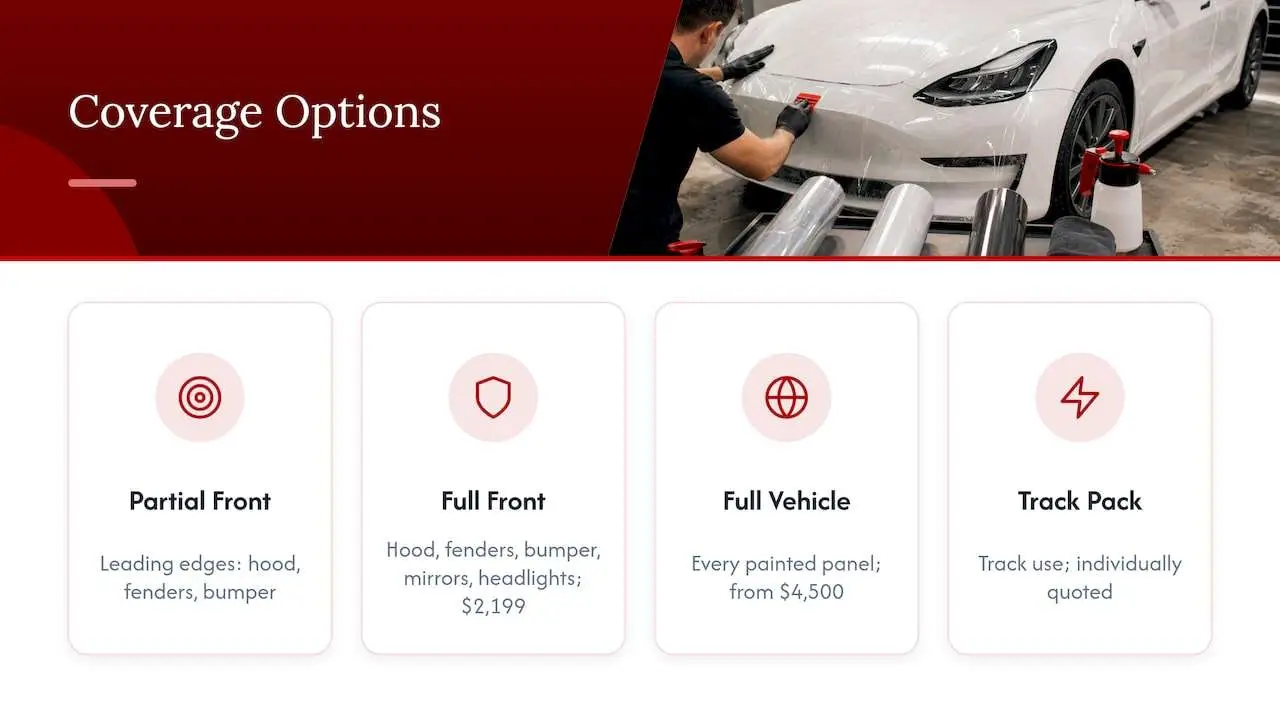
Partial Front. The leading edges: part of the hood, fenders and bumper. It targets the zones that take the most chips. Good for commuters who want an economical start.
Full Front. The full hood, fenders, bumper, mirrors and headlights, according to the package we sell. This is the most popular choice for daily drivers in Los Angeles, where freeway driving and construction debris are routine. It is published at 2199 USD. You can see the details on our Full Front page.
Full Vehicle. Every painted panel. This is the choice for owners of new luxury cars, exotics, and any white car where you want zero exposure. It starts from 4500 USD, and the final quote depends on the car. See the Full Vehicle, Partial Front and Track Pack options.
Track Pack. A package built for cars that see track days and aggressive use. We quote this one individually.
For white cars specifically, our advice is to think about wrapped edges. On a white panel, a film edge that ends in a visible line, collects dirt and starts lifting is the first thing anyone notices. Wrapping the film around panel edges where possible, rather than stopping short, makes the film nearly disappear.
Perspective: what we see on white cars
We install film on daily drivers, Teslas, luxury cars and exotics across Los Angeles, and white shows up all the time. Here is how we think about it.
White is an honest color. It does not hide a poor installation, and it does not forgive a cheap film. That is why we do not treat white as a special upsell. We treat it as a test of the process. If the edges are wrapped cleanly and the alignment is right on a white hood, the same work will look excellent on any other color.
Three habits matter most for us:
- Premium material. We use XPEL, and as an authorized installer we stand behind what we put on your car. The film is the part you cannot fix by polishing later.
- Precision cutting and finishing. Wrapped edges and clean alignment are the difference between film you forget about and film you keep noticing.
- Plain communication. You get a clear quote and a same-day response, not a vague range.
Our advice for most white car owners is simple: clear film on the zones that take damage, a ceramic coating over it if you want easier washing, and no film on panels that do not need it unless you plan to keep the car a long time. For a brand-new white car you love, go Full Vehicle and stop thinking about it.
— Jake
Adding a ceramic coating
Ceramic coating and PPF do different jobs. Film absorbs physical impact from chips and abrasion. A ceramic coating adds a slick, hydrophobic surface layer that makes dirt release more easily. On white paint, that second benefit has real value, because road grime and water spots are easy to see.
We offer a 5-year System X ceramic coating. Owners often pair it with film: film takes the hits, coating makes the car easier to keep clean. We do not publish a price for coating, because it depends on the car, so ask for a quote on our ceramic coating page.
If you are comparing the two, the Reddit-style question of which is better for white cars is the wrong frame. If you drive on freeways, film protects against chips and a coating does not. If you mostly park in a garage and want easy washing, coating alone may be enough.
What to ask before you book
Use this checklist with any installer, ours included.
- Which film brand and product line will you use? Get it in writing.
- What does the warranty cover? Manufacturer warranties differ on yellowing, staining, cracking and peeling. Ask what the claim process is.
- How do you handle edges? Ask whether the film wraps panel edges and where seams will fall.
- Is the car prepared before install? Contamination trapped under film shows on white as tiny specks.
- Is the install done indoors? Dust is the enemy of a clean finish.
- Can I see a finished white or light car? Photos in good light are fine, but a visit is better.
- What is the aftercare plan? Ask how long to wait before washing and what products to avoid.
If an installer cannot answer these without hesitation, keep looking.
Cost: what PPF for a white car runs in Los Angeles
Price depends on coverage, vehicle size and film type. Our published pricing:
| Package | Price |
|---|---|
| Full Front | 2199 USD |
| Full Vehicle | from 4500 USD |
| Full Color Change Wrap | from 2800 USD |
| Partial Front, Track Pack, Ceramic Coating, Chrome Delete, Auto Detailing | Quote on request |
A few things move the number. Large vehicles and cars with complex bumpers take more film and more time. Color film costs more than clear. Add-ons like coating are priced separately.
For context on materials, raw roll prices vary widely. One distributor lists 3M Series 100 Gloss film from 39.60 USD for small cuts, with larger rolls priced in the hundreds of dollars. The film itself is only part of the cost of a good job: the skill, the pattern work and the shop time are what you are paying for, which is why a DIY roll rarely ends up cheaper on a car you care about.
If your car is black, the clear-versus-black film question has its own considerations, which we cover in our guide to PPF for black cars.
Caring for PPF on a white car
Good aftercare is simple, and it keeps the film looking like new.
- Wait before the first wash. Follow your installer’s guidance on cure time. Ours will tell you when your car is ready.
- Hand wash with a pH-neutral soap and clean microfiber, or use a touchless wash. Avoid harsh brushes.
- Clean bird droppings and bug residue promptly. They are acidic and can stain if left in the sun.
- Keep pressure washers back from the edges. A close, angled jet can lift an edge.
- Do not wax or polish over film with abrasive products. Use products made for film or coating.
- Check the edges every few months. Dirt lines on white tell you it is time for a wash, not a problem.
If your film is ever damaged or you want it off, removal should be done by a professional, since pulling film or wrap off aggressively can harm paint. For wraps, see our guide on what wrap removal costs.
Book PPF for your white car in Los Angeles
We are a vehicle styling shop in North Hollywood. We install XPEL paint protection film, vinyl wraps, ceramic coatings and chrome deletes, and we have a 4.9-star rating from the customers we serve. Tell us your car, your driving and your budget, and we will recommend a coverage level and give you a clear quote, usually the same day. Start with our PPF packages, or the Full Front package if you want the most popular protection for daily driving. You can also see the film brands we work with on our 3M brand page.
FAQ
Does a white car require PPF?
No, but it benefits from it. White hides light swirl marks, yet it shows rock chips, tar and staining clearly, and matching white or pearl paint after a repair can be difficult. A Full Front package covers the zones that get hit most.
Will PPF turn my white car yellow?
Film quality decides this. Older and cheaper films have a reputation for yellowing, and it shows most on white. Choose a premium film such as XPEL, ask for the warranty terms in writing, and have an experienced installer do the work.
Should I choose clear PPF or white color PPF?
If your car is already white, clear film protects the paint without changing the look. White color film is for owners who want to change the shade or finish, such as going from another color to matte or pearl white, while still getting a protective urethane layer.
Do white cars hide scratches?
Fine swirls and light scratches are less visible on white than on dark colors. Deep scratches, chips and stains still show, and they are what film is designed to prevent.
Sources
- 3M Paint Protection Film Series 100, 3M United States
- Scotchgard Paint Protection Film Pro Series 200 Gloss technical data sheet
- PrismaPro Dry-Apply Color PPF, Avery Dennison
- 3M Paint Protection Film Series 100 Gloss, Accent Distributing