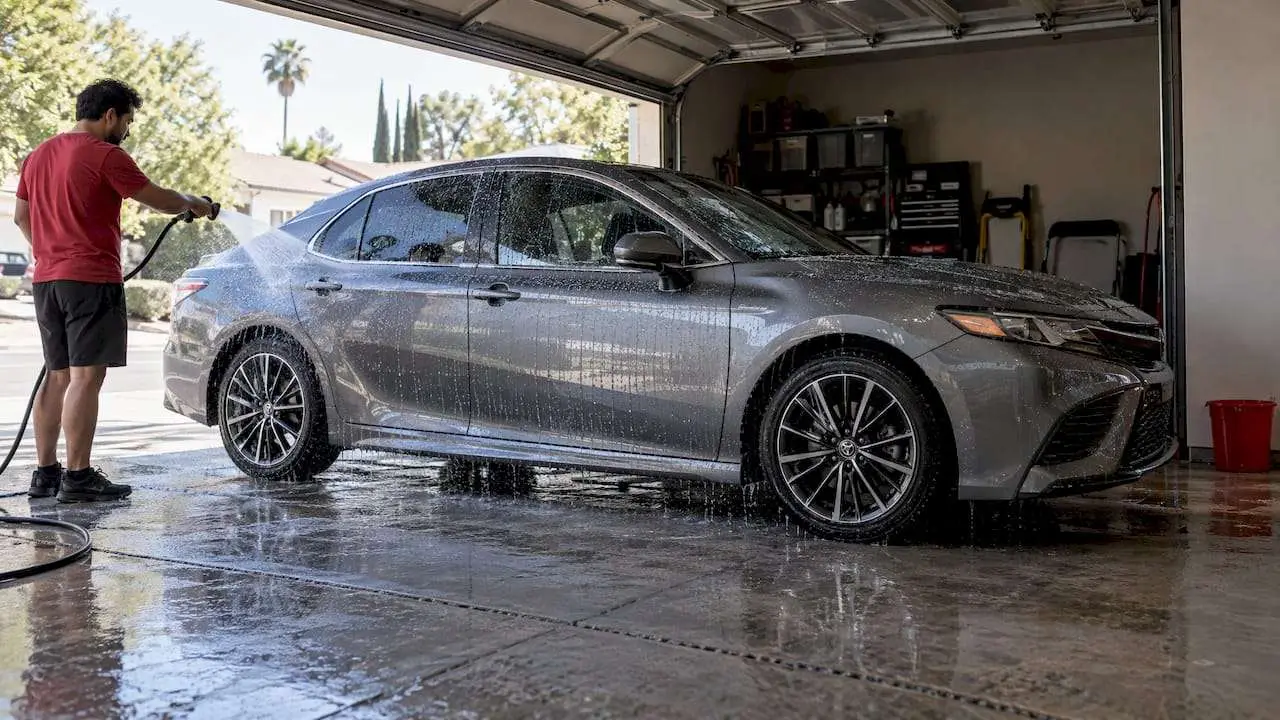
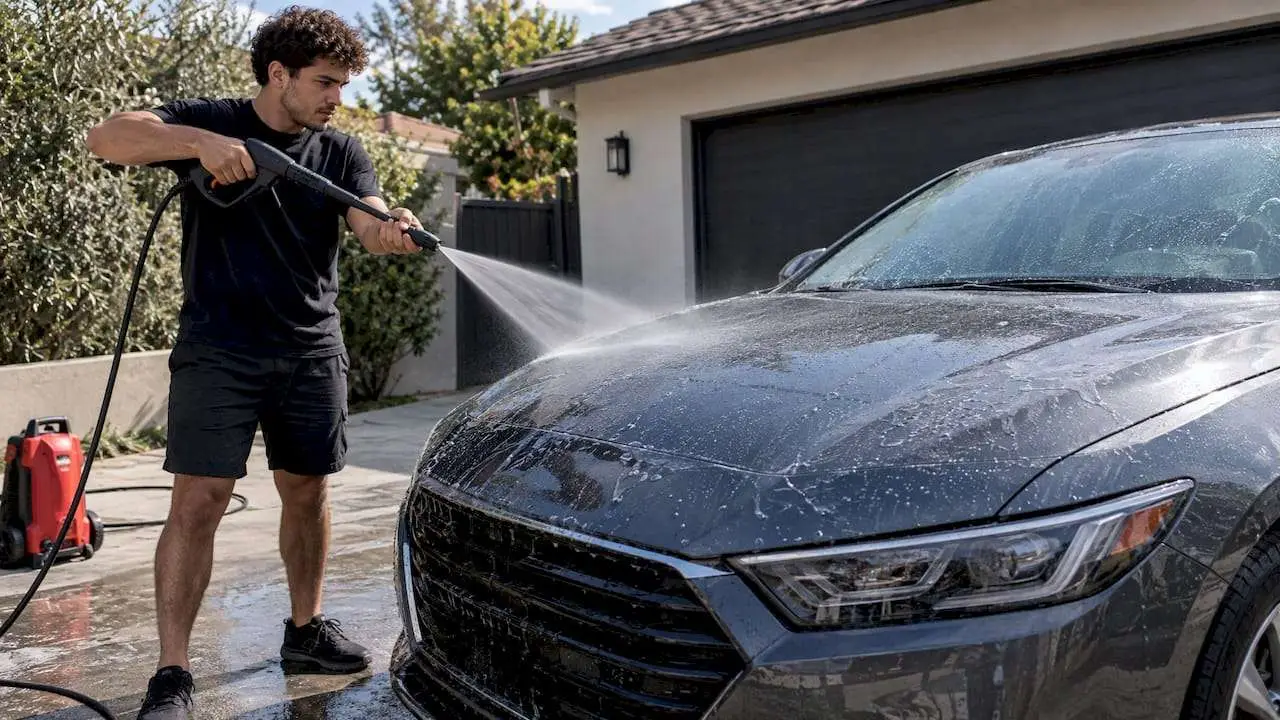
Yes, you can use a pressure washer on paint protection film (PPF), and for most daily drivers it is the easiest way to rinse off grit before a hand wash. What protects the film is technique: a wide fan nozzle, real distance from the panel, no spray aimed at an edge or seam, and no washing until the film has settled after installation. XPEL, the film brand we install, tells owners to stay about 3 ft (roughly 1 m) from the paintwork with a pressure washer. Get those habits right and the washer is a tool, not a risk.
TL;DR
- You can pressure wash PPF. Keep the nozzle about 3 ft from the paint, use a wide fan tip, and never point the stream at an edge, seam or corner.
- Wait at least 48 hours after installation before the first wash, per XPEL’s film care guidance. Follow your installer’s own timing if it is longer.
- Use the washer to rinse and to lay down foam. Do the actual cleaning with a soft mitt and pH-neutral soap.
- Most damage comes from a narrow jet held close to a film edge, not from pressure alone.
- Skip the brush-style automatic wash and harsh, wax-heavy or chemical-heavy products.
Table of Contents
- Why a pressure washer can hurt PPF at all
- The safe setup: distance, nozzle and pressure
- Where never to aim the spray
- When can you first wash a new PPF install?
- A wash routine that uses the pressure washer well
- Products and habits to avoid
- Quick reference table
- Does the type of PPF install change how careful you need to be?
- Perspective
- Protecting the car you just invested in
- FAQ
- Sources
Why a pressure washer can hurt PPF at all
Paint protection film is a clear urethane layer that sticks to your paint. Across the middle of a hood or door it is bonded over a large area, so water alone rarely bothers it. The weak points are the places where the film ends: the edges, the seams between pieces, and the corners cut around headlights, mirrors and door handles. If a jet of water gets under one of those edges, it can lift the film and let in dirt and moisture.
Two things decide how much force reaches that edge:
- Distance. Pressure drops quickly as the water travels. A nozzle six inches away hits far harder than one three feet away, even on the same machine.
- Spray angle. A wide fan spreads the same water over a bigger area. A narrow, pinpoint stream concentrates it on a small spot. A narrow jet at 12 inches and a wide fan at the same distance are not the same force on the film.
That is why the pounds-per-square-inch (PSI) number on the box matters less than where and how you point the wand. A 2,400 PSI electric washer is not automatically unsafe, and a smaller one can still do damage if you hold it a few inches from a corner.
The same logic appears in vehicle manuals. Mazda’s owner’s manual, for example, says to keep at least 12 inches (30 cm) between the nozzle and the vehicle at a high-pressure wash, to avoid dwelling on one spot and to take care around door gaps and windows, because close spray can force water inside and damage moldings. Film is more sensitive at its edges than paint is, so the sensible margin is wider.
The safe setup: distance, nozzle and pressure
Distance
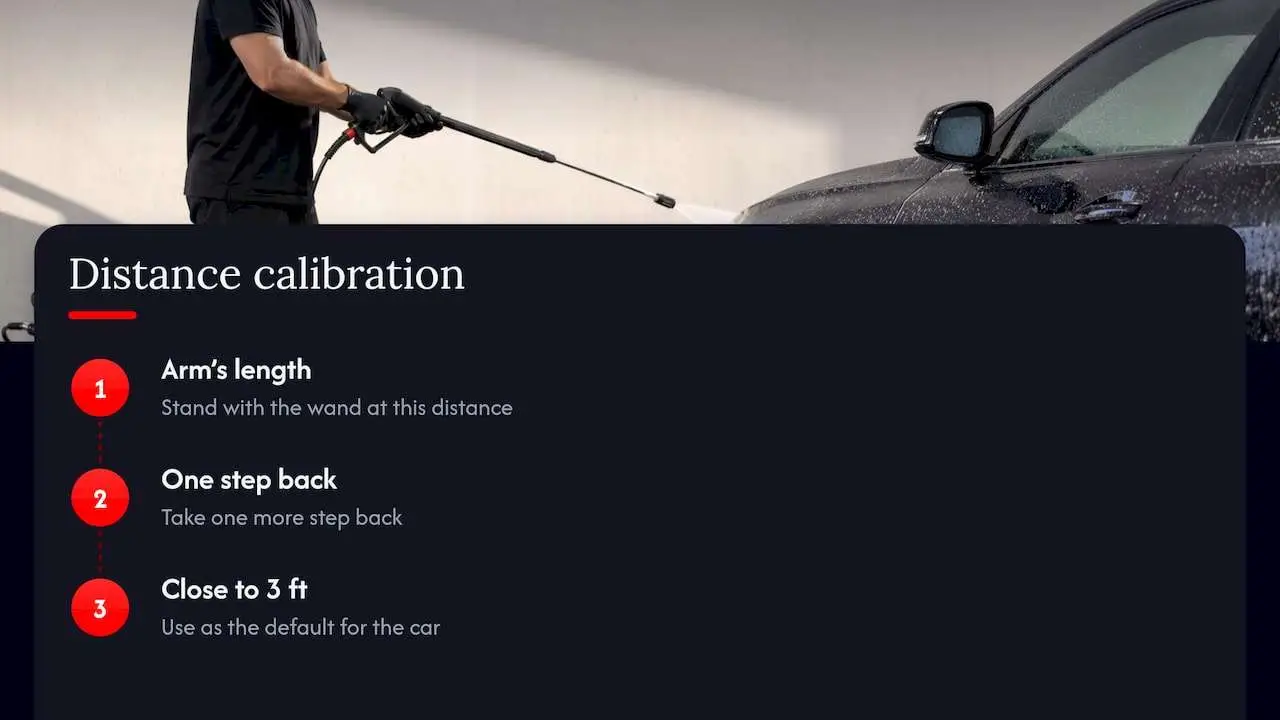
XPEL’s published film care says to stay 3 ft away from the paintwork when using a pressure washer. Treat that as your default for the whole car. On open, flat panels such as the middle of the hood, roof and doors you may be tempted to creep closer. Resist it. The extra foot of distance costs you nothing and removes the risk of a slip near a seam.
A simple way to calibrate: stand with the wand at arm’s length, then take one more step back. For most people that lands close to 3 ft.
Nozzle
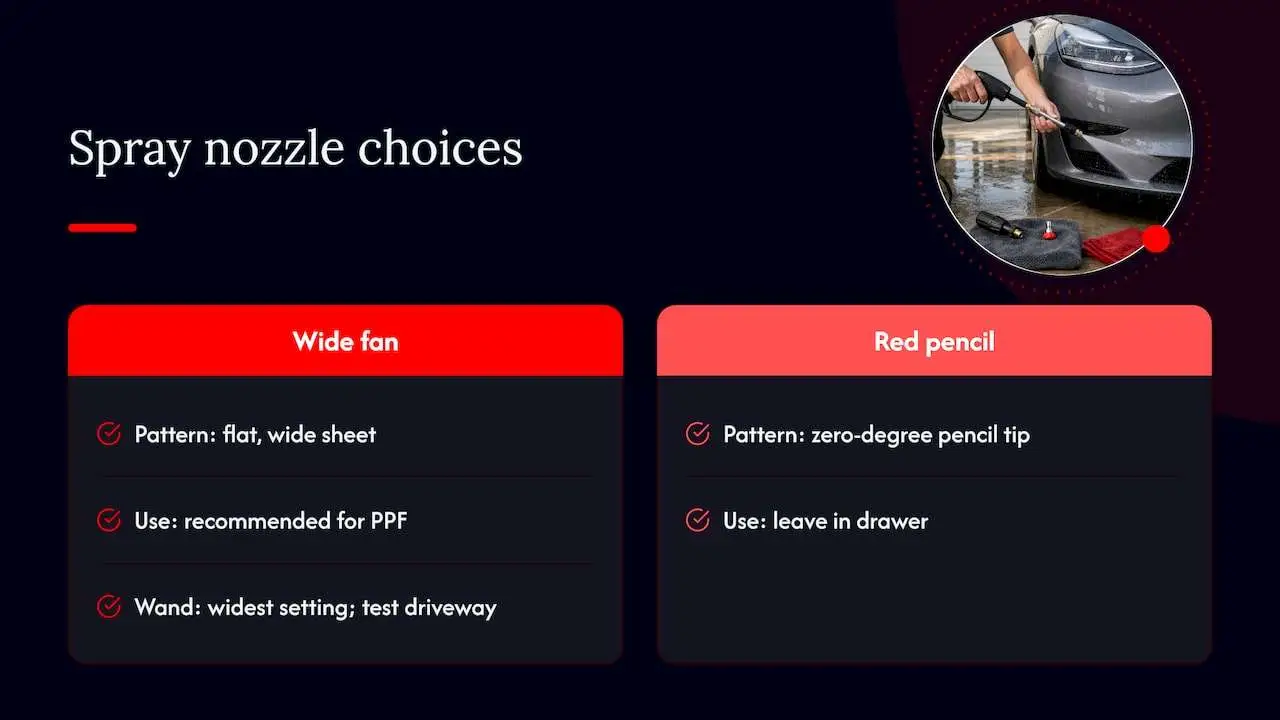
Use the widest fan tip your washer came with, the one that throws a flat, wide sheet of water. Leave the red, zero-degree pencil tip in the drawer. If your machine has an adjustable wand, set it to its widest pattern, and test it on the driveway rather than on the car.
Pressure
A standard consumer electric washer, used with a wide fan and proper distance, is the right class of tool for a PPF car. Commercial-grade gas machines are harder to control, so if you own one, back off further and keep the trigger moving. Hot water is also unnecessary and best avoided, since you are only rinsing dirt, not stripping grease.
Movement
Keep the wand moving in sweeping passes, the way you would paint a wall. Do not hold it on one spot. Mazda’s manual makes the same point about not spraying one area for too long.
Where never to aim the spray
These are the spots where film lifts, so give them extra room or skip them with the washer and rinse by hand:
- Film edges. Spray across the edge, parallel to it, or from well back. Never straight at it.
- Seams between film pieces. Bumpers and fenders on a full-vehicle install often have a seam or a wrapped edge.
- Corners and cutouts. Around headlights, fog lights, mirror caps, door handles and the lower rocker area.
- Panel gaps and trim. Water forced into these spots can reach places you do not want it.
- Stone-chipped or already-lifting areas. If you see a corner starting to curl, do not blast it. Have it looked at first.
If an edge is visibly lifting, XPEL tells owners to contact their authorized dealer for any damage, however small. A lifted corner is a quick fix early and a bigger job after it collects dirt.
When can you first wash a new PPF install?
Bring the washer out too early and you risk disturbing film that is still settling. XPEL’s care page for its protection film says to wait 48 hours after installation before washing. Other film makers and installers sometimes ask for longer, and heavily curved bumpers can need more patience than flat panels.
Practical rules for a fresh install:
- Follow the timing your installer gives you, even if it is longer than 48 hours.
- Skip the pressure washer for the first wash if you are unsure, and use a gentle hand rinse instead.
- Small water bubbles or a slightly hazy look right after installation are common as moisture works out of the film. Do not poke or press at them.
For the full timing and what to expect in the first weeks, our guide on how to wash a car after PPF walks through it step by step.
A wash routine that uses the pressure washer well
A pressure washer is at its best at the start and the end of a wash. Here is the order we recommend:
- Rinse the car from the top down. Wide fan, 3 ft out, moving constantly. The goal is to knock off loose dust and grit so your mitt does not drag it across the film.
- Rinse wheel wells and lower panels first if they are muddy, keeping away from the bottom edge of any film.
- Apply a pH-neutral foam or shampoo. Let it sit briefly, but never let it dry in the sun.
- Hand wash with a soft microfiber mitt, in straight lines rather than circles, and rinse the mitt often. Use separate mitts for the body and the wheels.
- Rinse again with the same wide fan and distance, from the top down so soap does not streak.
- Dry with a clean, plush microfiber towel or a gentle blower. If you use a blower, keep the nozzle back from film edges.
- Deal with bird droppings, bugs and fuel spills quickly. Soak them to loosen rather than scrubbing them dry.
XPEL also notes that detailing clay can remove contaminants that sit on its film, and that light scratches in its Ultimate Plus film self-heal at room temperature, faster with warm water poured over them.
Weekly or every two weeks?
You do not need to wash constantly. For a daily driver in Los Angeles, a regular schedule with a quick rinse in between keeps dust and road film from bonding. Our PPF maintenance schedule for busy owners lays out an every-two-weeks wash and a yearly check, which suits most people.
Products and habits to avoid
The pressure washer is rarely the problem on its own. These habits do more harm:
- Brush-style automatic washes. Spinning brushes carry grit from the cars before yours and can swirl or catch an edge. Hand washing is the safest routine.
- Wash-and-wax and gloss-enhancing soaps. They can leave residue and uneven build-up, especially on matte or satin film.
- Harsh acidic or alkaline cleaners. Stick with a pH-neutral shampoo.
- Aggressive scrubbing of dried contaminants. Soak first, then wipe.
- Pressure washer lances held close for “stubborn spots.” If a spot will not rinse off, it needs a soft touch and the right cleaner, not more force.
- Dragging a dry towel across a dirty panel. Rinse first, always.
Be careful with solvents too. XPEL’s guidance for its stain removal is specific to the product: its own film cleaner for insect stains first, and isopropyl alcohol only for stubborn marks, kept off the surrounding paint.
If your car also has a ceramic coating on top of the film, the same wash rules apply, and the coating makes rinsing off dirt easier. See our page on XPEL ceramic coating for how it pairs with film.
Quick reference table
| Question | Safe approach |
|---|---|
| How far from the car? | About 3 ft, never closer than 12 inches anywhere |
| Which nozzle? | Widest fan tip available, never a pencil jet |
| Where to avoid? | Edges, seams, corners, cutouts, panel gaps |
| When can I first wash? | At least 48 hours after install, or longer if your installer says so |
| What soap? | pH-neutral shampoo, no wax or gloss additives |
| How to dry? | Plush microfiber towel from the top down |
| Brush car wash? | Skip it |
Does the type of PPF install change how careful you need to be?
A little. Coverage determines how many edges the film has:
- Full front (hood, fenders, bumper, mirrors): edges run along the cowl, fender lines and around the headlights. Take the most care there.
- Full vehicle: more panels, more seams, and wrapped edges around door jambs and panel gaps. A well-installed full wrap hides most edges, but you still avoid blasting them.
- Partial front or track packages: film on the nose and leading edges, where the exposed edges sit in the path of your spray.
If you are choosing coverage with your washing habits in mind, our new car protection film guide explains what is worth covering first. Prices for our standard packages are published: the Full Front package is $2,199, and Full Vehicle starts from $4,500.
Perspective
When someone picks up their car from us, the first question about maintenance is almost always the pressure washer. People expect a list of rules. The truth is simpler: a gentle, wide rinse is fine, and a tight jet at an edge is the thing to avoid.
That is also why we put so much effort into the install itself. Our approach is precision: wrapped edges and clean alignment, using XPEL film as an authorized installer. Edges that are tucked and finished properly give your wash routine the best possible footing, because there is less exposed to lift in the first place.
Our advice to every owner is the same. Respect the first-wash wait, keep your distance, rinse wide, wash by hand, and ask us if something looks off. We reply to quote and care questions the same day.
Jake
Protecting the car you just invested in
The point of PPF is that your paint takes the rock chips, bug acid and road grit instead. The wash routine above keeps the film clear, glossy and attached for the long haul, so the protection and the resale value you paid for stay intact.
If you are in Los Angeles and thinking about film, we install XPEL paint protection film at our North Hollywood shop, with coverage from a Full Front package to a full vehicle wrap, and we can add a ceramic coating to make washing easier. Tell us your car and how you drive it, and we will recommend the coverage.
If your car has been through a polish, a coating or a repaint, a proper decontamination wash before film goes on helps it bond cleanly.
FAQ
Can you pressure wash a car with PPF?
Yes. Use a wide fan nozzle, stay about 3 ft from the paint, keep the wand moving and never aim at an edge, seam or corner. Wait out the first-wash period after installation before you start. A gentle, wide rinse is a normal part of caring for filmed paint.
How far should a pressure washer be from PPF?
XPEL’s film care guidance says to stay about 3 ft away. Never go closer than 12 inches on any panel, and add distance near edges, seams and corners. If you are unsure, step back.
Can I take a PPF car through an automatic car wash?
We recommend hand washing as the safest routine. If you ever choose an automatic wash, avoid brush-style tunnels, since the brushes can drag grit across the film and catch on edges. For a new install, wait until the film has settled before any wash.
What should I not use on PPF?
Avoid wax-heavy or gloss-enhancing soaps, harsh acidic or alkaline cleaners, abrasive pads and dry scrubbing of dirt. Stick with pH-neutral shampoo and soft microfiber. For stains, use a film-safe cleaner and soak the spot before wiping.
How long after PPF installation can I wash the car?
XPEL’s guidance for its protection film is to wait 48 hours. Follow any longer timing your installer gives you, especially for a full-vehicle job or cooler, damp weather. Our post-PPF washing guide covers the first weeks in detail.