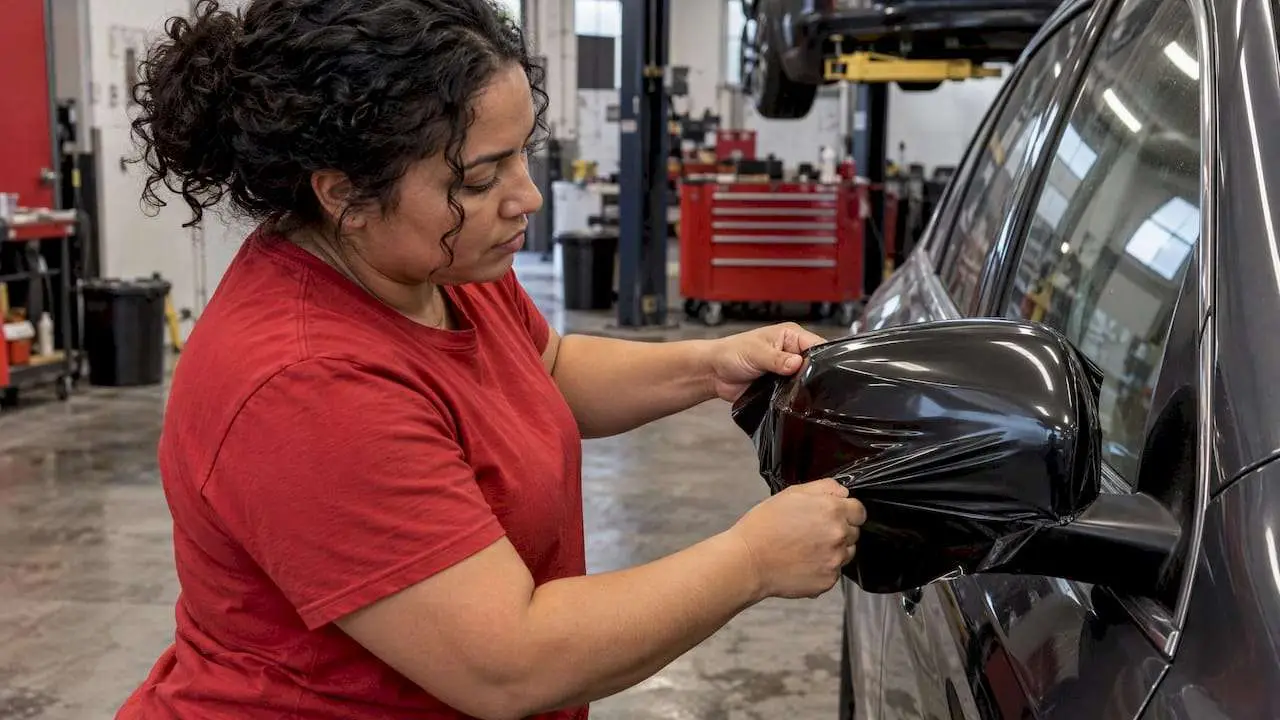
Every car wrap is stretched somewhere. The question is how much, where, and what the installer does afterward. Film stretched a little over a bumper and then heat-set stays put for years. Film stretched hard into a recess and left that way slowly pulls back, which shows up as lifted edges, gaps, faded color and shrinkage. That is why two wraps made from the same roll of vinyl can look identical on delivery day and very different a year later. Stretching is a skill, and it is the main thing you are paying for when you hire a professional installer.
This guide explains what stretching does, where it is safe, where it causes stretch marks and shrinkage, and what a careful installation looks like on your car.
TL;DR
- All wrap film is stretched during installation. The goal is to stretch it as little as the shape allows and to relax it afterward with heat, not to avoid stretching altogether.
- Overstretching causes the most common long-term failures: edge lifting, pop-back out of recesses, color shift and shrinkage gaps.
- Flat panels need tension control, not stretch. Mirrors, bumpers and fender arches need controlled pre-stretching and post-heating.
- Post-heating the same day is what locks the film down and releases stored stress.
- The best protection for your wrap is an installer who knows how to stretch without overstretching, on a film chosen for your car’s curves.
Table of Contents
- What stretching does in a vehicle wrap
- Stretch versus tension: two different moves
- How much stretch is too much
- What overstretching looks like: stretch marks and color shift
- Why wraps shrink and lift after installation
- How a careful installer stretches around curves
- Post-heating: where shrinkage is prevented
- Weather and workspace matter
- Signs your wrap was stretched well
- Our view on stretching
- Get a wrap planned around your car’s curves
- FAQ
- Sources
What stretching does in a vehicle wrap
Vinyl wrap film starts as a flat sheet. Your car is not flat. Wherever a panel curves deeper than the film can lay down on its own, the installer has to make up the difference, and stretching the film is how that happens.
The catch is that vinyl has memory. Arlon, a wrap film manufacturer, describes what it calls the golden rule of wrapping: vinyl always wants to return to its relaxed state, and the installer’s job is to make sure that when it relaxes, it pulls toward the car rather than away from it. The wrong technique leaves stored energy in the film, and that energy shows up later as shrinkage, lifting and early failure.
The same maker explains the mechanism with a rubber band comparison. Even premium cast vinyl comes off the roll stress-free, but stretching it around a bumper pulls on its internal fibers. If it is stretched into a recess and left there, the adhesive fights a constant tug-of-war against the film’s memory until sun heat or road vibration lets the film pop back out.
Stretch versus tension: two different moves
Installers use two techniques that look similar to an owner watching but do opposite jobs.
Pre-tension is a low-energy, usually cold move for large flat panels such as hoods, doors and roofs. It simply removes slack so the film lies flat. Pre-stretch is a high-energy move for parts that are deeper or rounder than the flat film, like mirrors and door handles. According to Arlon, pre-stretch deliberately tricks the vinyl’s memory so it shrinks onto the object, and it is meant for three-dimensional shapes only.
Using pre-stretch on a flat door is a mistake, and so is trying to wrap a mirror with nothing but tension. Choosing the right move for each panel is a large part of what separates a clean job from a rushed one.
How much stretch is too much
Manufacturers publish numbers, and they are lower than most owners expect:
| Source | Guidance |
|---|---|
| Arlon SLX installation guide | Heat range of 105°F–120°F (40°C–50°C) and a maximum stretch of 25%, which may be lower depending on the print system and ink saturation |
| Avery Dennison IB 1.20 | Keep stretching to an absolute minimum, within 10–20% for the best result, and spread it over more material |
| Avery Dennison certification guide | Film stretched around 3–5% shrinks back when light heat is applied to the edges before cutting |
Notice the pattern. Even the generous limits are a ceiling, not a target, and the best results come from stretching far less. Metamark’s application guidelines add a reason: stretching film by just 50% thins the adhesive and can reduce adhesion by 35%. A wrap with thinned adhesive on a curve is exactly where lifting starts.
Avery Dennison’s training material states the principle plainly: all film needs to be stretched while wrapping, and the key is learning to stretch without overstretching.
What overstretching looks like: stretch marks and color shift
When people search for “wrap stretch marks,” they usually mean visible distortion in the film: patches that look lighter, duller or streaky where the vinyl was pulled too far. Stretched vinyl can also hold a different shape from the cut line the installer drew. In one demonstration, an experienced installer showed the cut line sitting a half inch to an inch farther out than the overstretched line, which shows how much the film relaxes once the tension is gone.
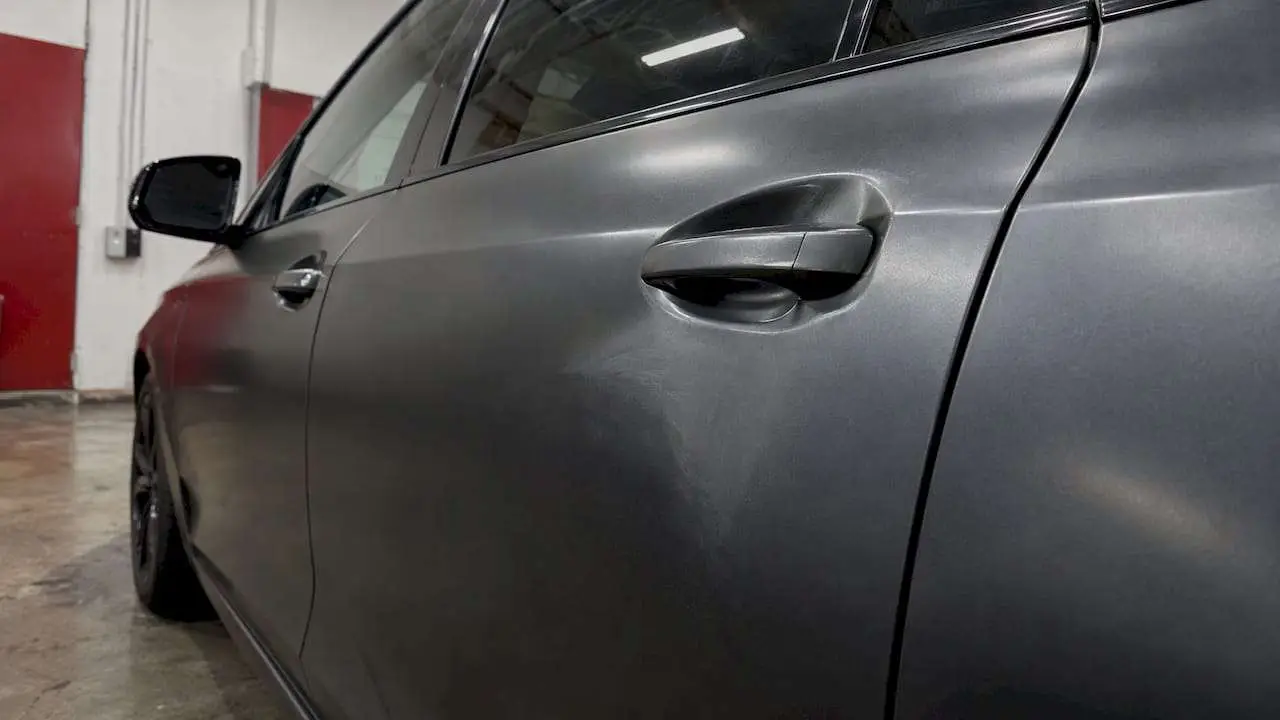
Texture and color matter most on specialty finishes. Hexis’s technical data for its HX20000 series notes that glitter and metallized gloss films slightly mattify when stretched. The entire film should be warmed slightly and stretched evenly during application to avoid visible demarcations. The same sheet notes that matte films are fragile and sensitive to scratching and pressure marks. Arlon likewise says that pushing film into grooves can visibly change its color or texture.
If you are choosing a satin, metallic, chrome-look or matte color, finish matters when planning stretch. These films show uneven stretching more readily than a plain gloss color.
Why wraps shrink and lift after installation
“Wrap shrinkage” is almost never the film simply getting smaller. It is stretched film releasing its stored tension. There are a few typical causes.
Overstretched film on edges. Arlon’s installation tip on outgassing warns that stretch exerts strong shrinkage forces as the film dries and hardens, particularly on edges. Avery Dennison’s vehicle wrap guidelines say vinyl must be stretched as little as possible to minimize lifting, and that some shrinkage can leave a gap at a relief cut if the film was over-stretched.
Film type. The same Avery Dennison guide notes that calendered films have memory for their original shape, so heating and stretching them can cause shrinkage, tenting and lifting on compound curves. Cast films are preferred for contoured surfaces, but even they can tent when over-stretched or overheated. Match the film to the car.
Heavy heat. Limiting heat matters. Arlon says that keeping heat in its specified range stops the film from becoming too stretchy, which can lead to image distortion, color shift and significant shrinkage.
Deep recesses. Avery Dennison says that in deep recesses, or three or more consecutive ones, adhesion may be reduced and lifting may occur. For those areas it strongly recommends inlay or overlay techniques, meaning a separate piece of film rather than one stretched piece.
How a careful installer stretches around curves
Here is the sequence a well-trained installer follows on a complex area such as a bumper, mirror or fender arch. At each step, the choice of technique is what protects your wrap.
- Prepare the surface. Avery Dennison lists a properly cleaned vehicle as the first of four key factors, ahead of film choice, avoiding overstretching and post-heating. Contamination under the film is a lifting risk no stretch technique fixes.
- Choose the film and the plan. The film’s type and finish decide how much stretch it tolerates. Where a recess is too deep, a second piece (inlay) is used rather than stretching one.
- Anchor and lay out the film. For compound curves, Avery Dennison describes a triangle method combined with cold pre-stretch: spread the film out in a triangle, anchor the corners first, then squeegee it to the surface.
- Keep stretch off the edges. Arlon’s installation guide instructs installers to avoid or minimize stretch on areas that will be cut, such as edges, wheel wells, seams and overlaps, because stretched edges curl and lift over time. Avery Dennison recommends edge-wrapping with a minimum 5–8 mm allowance from the edge.
- Heat in the flat, apply into the recess cold. WrapItRight’s tutorial calls the most common applicator mistake pushing hot, stretched vinyl into channels, where it pops back up over time. The better approach is to warm the film on a flat area and apply cold, unstretched vinyl into the channel, so any stretch sits in material that gets cut away. Metamark’s guidelines add that for double channels, the film goes on one side at a time.
- Make rounded relief cuts when needed. Avery Dennison specifies that relief cuts must be rounded rather than straight, to prevent unintentional tearing.
- Squeegee with overlapping strokes. Arlon’s SLX Plus guide calls for firm pressure with strokes overlapping by about 50% of the squeegee’s width for full adhesive contact.
- Post-heat. This is the step that locks everything in, covered next.
Techniques for applying vinyl to complex vehicle contours such as pre-stretch, cold application and relief cuts all follow the same logic: confine stretch to material that gets trimmed away, and keep the visible film relaxed.
Post-heating: where shrinkage is prevented
Post-heating means heating stretched or edge areas after the film is on so it relaxes and bonds firmly. It is not optional. Avery Dennison’s certification guide calls it key to durability.
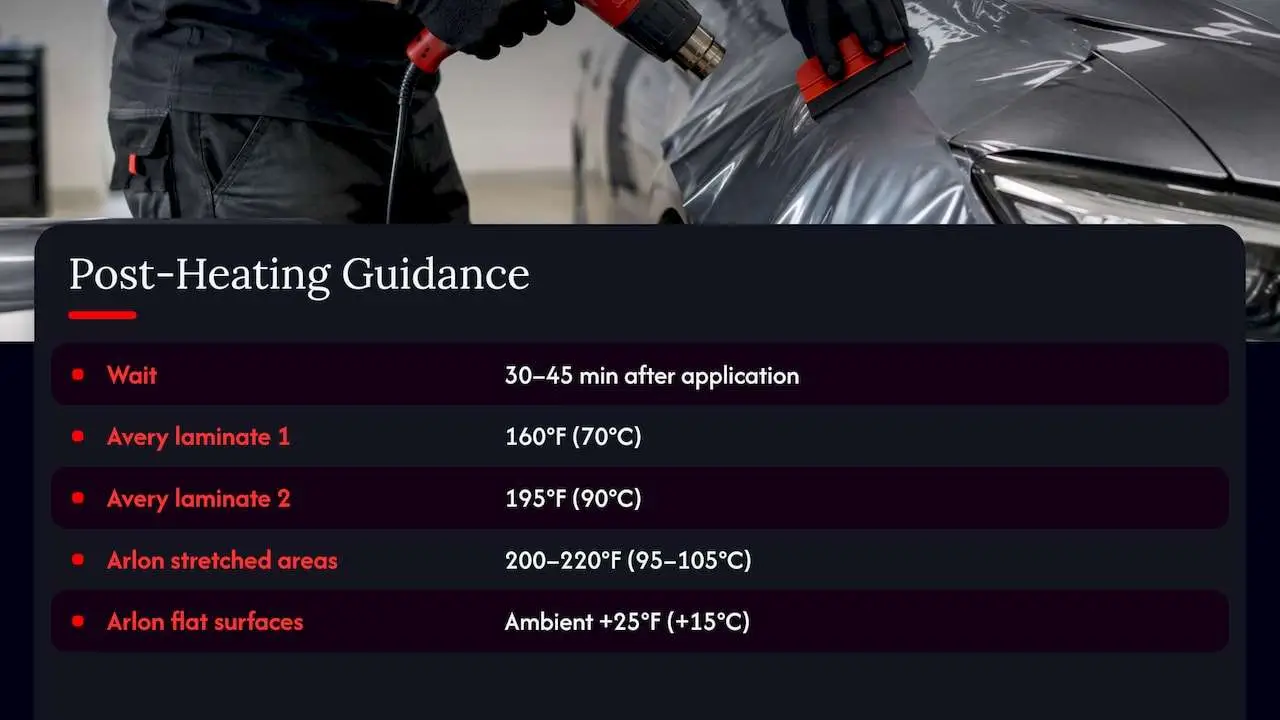
The numbers depend on the film. Avery Dennison’s vehicle wrap guidelines say post-heating must be done no sooner than 30 to 45 minutes after application and on the same day, until the conformed area reaches 160°F (70°C) for one laminate or 195°F (90°C) for another, and that every stretched area needs it. Arlon’s guide asks for at least 200°F–220°F (95°C–105°C) on edges, seams, corrugations and other stretched areas, and ambient temperature plus 25°F (+15°C) on flat surfaces.
One subtle point comes from Arlon’s tip on outgassing: passing a heat gun across a cut edge can release the adhesive and speed up edge shrinkage, so cut edges need a final squeegee stroke while the film cools. Teckwrap’s mirror article says to tuck the film again after post-heating before cutting so the edge carries no tension.
If you want to see how seams and edges are handled in practice, our page on wrap seams and edges covers where they sit on a car and how to keep them down.
Weather and workspace matter
Heat does not only come from the gun. Avery Dennison’s certification guide warns that if the workspace is too warm, film can easily overstretch, especially on edges and critical cuts, and recommends scheduling installations for early morning or evening in hot weather. Hexis recommends applying between 68°F and 77°F (20°C–25°C). In Southern California summers, that is a real consideration, and a controlled indoor shop is a more forgiving environment than a driveway.
Signs your wrap was stretched well
In the first weeks after pickup, look at the places stress concentrates:
- Edges and corners lie flat with no fingers or curling.
- Recesses and door handle cups show film sitting in the shape, with no bridging or air pockets.
- Color is even across a panel, with no lighter patches near curves.
- Mirror and bumper edges are wrapped around and tucked, not cut short with visible gaps.
Your care routine matters too. Our guidance on waiting 72 hours before the first wash gives the adhesive time to settle, and our guide on how long vinyl wrap lasts explains what to expect over the years. Keep your paperwork as well: a wrap warranty is only useful with documentation, as our page on wrap warranty paperwork explains.
Our view on stretching
Most wrap problems we hear about trace back to the same thing: stretch that went where it should not. A clean color on delivery day is easy. A clean color two years later takes an installer who plans where the stretch goes before the film touches the paint.
For us that means precision on the details owners notice last: wrapped edges, clean alignment, and film from trusted brands such as XPEL. We think a wrap should be judged by its edges and recesses, not just its flat panels, because that is where the work shows.
If you are weighing a wrap for a daily driver, a Tesla or a luxury car, ask yourself where the film has to bend most on your model, and choose a shop that can talk about that area specifically.
Jake
Get a wrap planned around your car’s curves
If you drive in Los Angeles and want a color change wrap installed with controlled stretch and wrapped edges, our Full Color Change Wrap starts from $2,800. We are a North Hollywood shop, and our quote process is built around same-day responses, so you can find out what your car needs quickly. You can browse finishes on our wrap options and color consultation page.
If you would rather protect paint than change color, our paint protection film services include Full Front at $2,199 and Full Vehicle from $4,500.
FAQ
Is it normal for vinyl wrap to stretch during installation?
Yes. Every wrap film is stretched somewhere to follow curves. The aim is to keep that stretch small, spread it over more material and relax it with post-heating. Manufacturer guidance generally treats stretch in the 10–25% range as the ceiling, with less being better.
Can a wrap shrink after it is installed?
It can if the film was overstretched. Stretched film tries to return to its original shape, which causes edge pull-back, gaps at cuts and lifting in recesses. Careful stretching, rounded relief cuts and same-day post-heating are how installers prevent it.
What are wrap stretch marks?
They are visible distortions where film was pulled too far: lighter or duller patches, texture changes and uneven sheen. They appear most on metallic, glitter and matte finishes, so the installer should plan the stretch carefully on those films.
Can overstretched vinyl be fixed?
Sometimes minor lifting can be corrected with heat, but Avery Dennison’s guidance for deep recesses is to use inlay or overlay pieces instead. Persistent lifting on a heavily stretched area usually means redoing that section. Contact us and we will look at it with you.
Sources
- Arlon: pre-stretch vs. tension
- Arlon: Why does vinyl pop back?
- Arlon SLX installation guide
- Arlon SLX Plus installation guide
- Arlon tip 38: channels
- Arlon tip 34: outgassing and installing
- Avery Dennison IB 1.20
- Avery Dennison IB 640 vehicle wrap guidelines
- Avery Dennison certification study guide
- Metamark application guidelines
- Hexis HX20000 series data sheet
- WrapItRight: managing heat and tension
- Teckwrap: wrap a mirror in one piece
- Justin Pate: overstretching