For most owners, a vehicle-specific precut mirror PPF kit protects mirrors affordably. Wrapped-edge or complex-shape installs are best left to a certified installer. The two main approaches are precut pieces, which go on faster but leave a visible seam, and wrapped or one-piece film, which covers the entire cap for a factory-like finish.
TL;DR:
- Install mirror PPF between 70°F and 79°F using a clay bar, degreasing, and wiping with 99% isopropyl alcohol; existing ceramic coatings may interfere with adhesion.
- Surface cut edges expose adhesive, so apply a thin, even bead of compatible sealant, especially along leading edges exposed to wind and road spray.
- A vehicle specific precut kit suits flat, gently curved caps, while complex shapes or wrapped edges often call for a professional installer.
- Wait about 72 hours before judging an install; small central bubbles may shrink with gentle heat and squeegee pressure, but persistent edge lift needs repair.
- For removal, warm the film to roughly 60°C and peel slowly; use a plastic tool and adhesive remover rather than scraping the clear coat.
Table of Contents
- Precut mirror PPF options: kit types and film choices
- Tools and materials you need (for DIY or to evaluate a shop quote)
- Installation methods: one-piece, multi-piece, and wrapped vs surface-cut finishes
- Surface prep and ideal environmental conditions for mirror PPF
- Edge finishing, sealing best practices, and safe removal steps
- Fit, common mirror PPF issues, and quick troubleshooting
- Why professional installation matters
- What matters most with mirror PPF
- Get a mirror PPF quote from PPF Pros
- FAQ
- Sources
Precut mirror PPF options: kit types and film choices
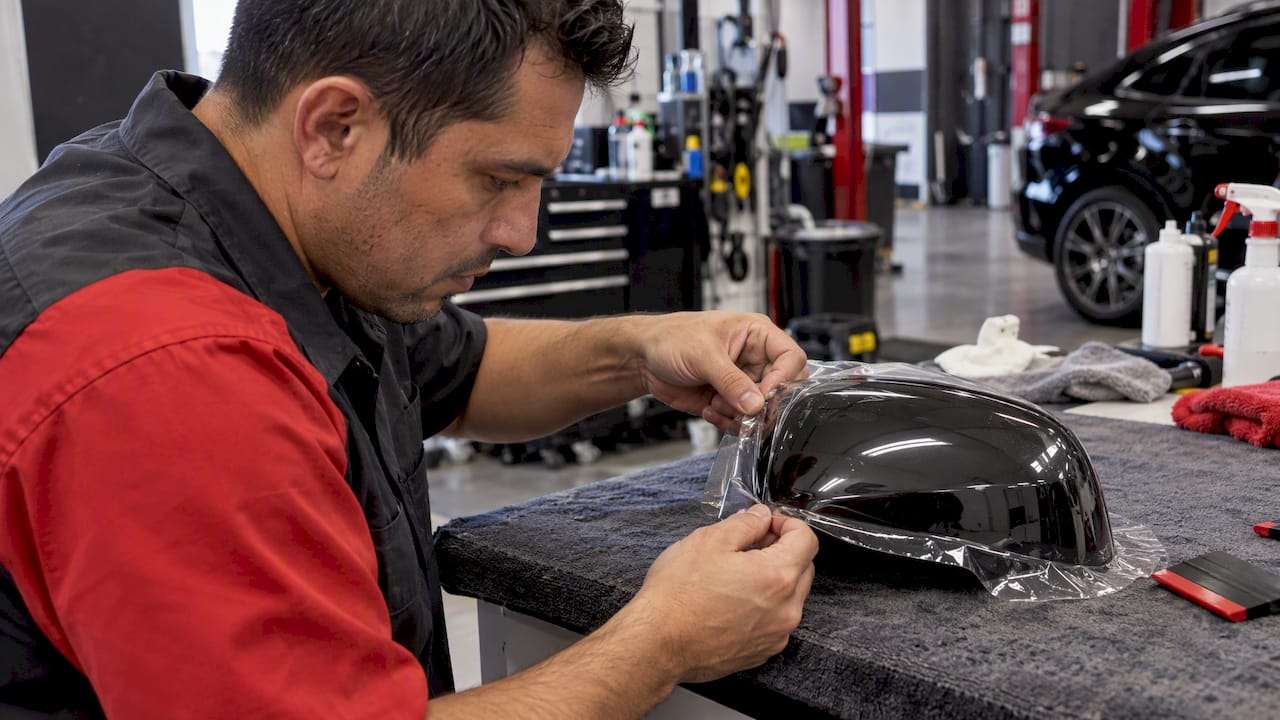
A vehicle-specific precut mirror kit is cut by a machine to match your exact mirror cap shape, based on your car’s year, make, and model. Fit is usually close, though some trimming at the edges is still common, especially around housing seams or turn signal cutouts. These kits are the easiest entry point for a DIY install because you are not cutting pattern lines by eye.
Universal sheets, sold as large uncut rolls or pre-sized rectangles, work better when no precut pattern exists for your vehicle or when you want extra material to wrap edges rather than terminate them at a seam. According to XPEL’s product FAQ, paint protection film is a transparent polyurethane film designed to guard against scratches, chips, stains, and UV damage, and colored PPF variants come in thicker constructions that change both protection level and appearance.
Film choice generally falls into a few camps:
- Clear TPU PPF for invisible protection that preserves the factory paint color.
- Colored or satin PPF for a cosmetic change alongside protection.
- Gloss or matte finishes that match or contrast with the rest of the body.
A flat-faced mirror cap with gentle curves is realistic for a careful DIYer using a precut kit. A deeply sculpted mirror housing, a two-tone cap, or anything you want wrapped around the back edge is where a professional installer earns the cost difference.
Tools and materials you need (for DIY or to evaluate a shop quote)
Whether you install the film yourself or want to judge a shop’s process, the tool list looks the same. A thin, uncut mirror install depends on precision tools, not just a steady hand.
- Soft and medium squeegees to move the film into place without scratching it, plus a small U-shaped mirror squeegee for tight edge curves.
- A heat gun, used at a safe distance to soften the film around curves and shrink out wrinkles.
- An infrared thermometer to confirm surface temperature during heating instead of guessing.
- A slip solution (usually water with a few drops of baby shampoo) to let the film float into position before squeegeeing.
- 99% isopropyl alcohol for the final pre-install wipe, which removes oils the slip solution cannot.
- A PPF-compatible edge sealant, microfiber towels, a clay bar, and an adhesive remover for cleanup or future removal.
Pro Tip: Keep the heat gun moving constantly and never hold it on one spot for more than a second or two: static heat can warp the plastic mirror housing underneath.
Installation methods: one-piece, multi-piece, and wrapped vs surface-cut finishes
Installers choose between a few structural approaches depending on the mirror’s shape and how much time the job allows. According to the PPF installation guide for professional installers, wrapped edges are considered the gold standard for permanent installations because they eliminate exposed adhesive edges entirely.
- One-piece wrapped installs cover the full mirror cap and tuck the film edge around the back, hiding the termination line completely.
- Multi-piece installs use two or more panels to cover complex shapes, which is faster but adds seams.
- Surface-cut finishes end the film on the visible face of the mirror rather than wrapping it, which is quicker but leaves an edge exposed to moisture.
Surface cuts are an acceptable practical choice when disassembly is not possible or the budget does not support a full wrap, but that same source notes they benefit from a compatible edge sealant to reduce moisture infiltration at the seam. Visible seams and exposed edges are mostly a cosmetic tradeoff, but an unsealed edge is also where lifting tends to start first.
Pro Tip: If your mirror cap has a sharp lip or a multi-angle housing, ask whether the installer plans to remove the mirror cap for a true wrap. Installing over an assembled mirror almost always means a surface cut.
Surface prep and ideal environmental conditions for mirror PPF
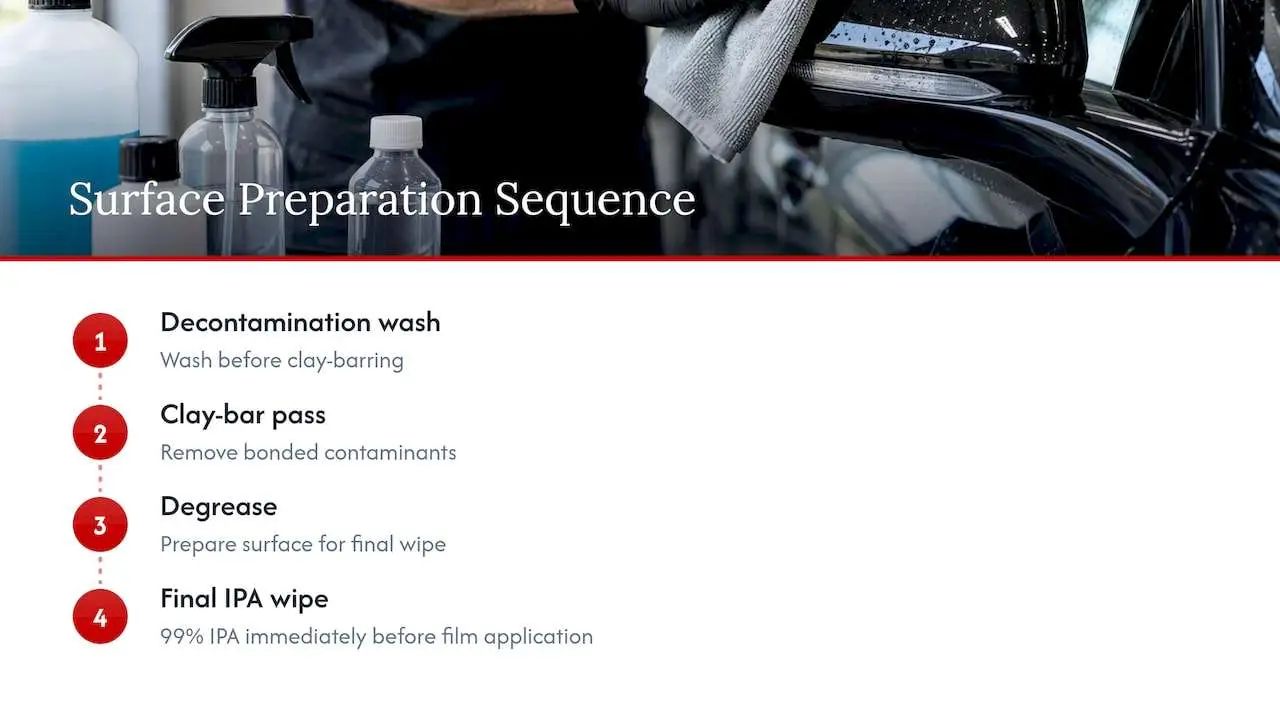
Surface prep determines whether the film bonds correctly or lifts within weeks, making a proper clay-bar pass essential as explained in this clay-bar prep before coating guide. The sequence that reduces installation defects is a decontamination wash, a clay bar pass to remove bonded contaminants, a degrease step, and a final wipe with isopropyl alcohol immediately before the film goes on.
According to 3M’s installation guideline, optimal PPF installation happens between 70°F and 79°F (21°C to 26°C), with a final 99% isopropyl alcohol wipe performed after degreasing and clay-barring to support adhesive bonding. Outside that window, adhesive can activate too slowly in the cold or too fast in the heat, making repositioning difficult.
Humidity matters too: in damp climates, moisture can work into any unsealed edge, which is part of why edge sealing is recommended on surface-cut installs. If your car already has a ceramic coating, confirm adhesion before committing to a full install, since some coatings can interfere with PPF adhesive bonding.
Edge finishing, sealing best practices, and safe removal steps
A wrapped edge tucks the film around the mirror cap so there is no exposed adhesive line at all. A terminated, or surface-cut, edge ends on the visible face and needs a thin bead of PPF-compatible edge sealant run along the seam to keep moisture from creeping underneath.
- Apply edge sealant in a single, even pass rather than a thick glob that can pool and discolor.
- Focus sealant on the leading edges that face wind and road spray, where lift starts most often.
- Let sealant cure fully before the car gets wet or goes through a wash.
When it is time to remove the film, heat does the real work. The KSB installation guide describes warming the surface to roughly 60°C to soften the adhesive, then peeling slowly rather than pulling in one motion, with any leftover residue cleaned off using isopropyl alcohol or a dedicated adhesive remover. Our guide on safe wrap removal temperatures covers the same heat-and-peel approach for larger panels.
Pro Tip: Never scrape a blade against the clear coat to lift stubborn film or residue. Heat and a plastic edge tool do the job without risking a scratch that the PPF was supposed to prevent.
Fit, common mirror PPF issues, and quick troubleshooting
Mirror caps with tight curve radii ask more of the film than a flat hood panel does, so some orange peel texture or light stretching at the tightest curves is normal and expected, not a defect. Problems usually show up as bubbles, lifting edges, or a hazy ring around the film’s border.
- Small bubbles near the center often shrink with gentle heat and a fresh squeegee pass within the first few days.
- Edge lift usually means the edge was not sealed or the adhesive did not get a clean, oil-free surface to bond to.
- Adhesive haze at the border typically points to contamination during install rather than a product flaw.
Give fresh installs about 72 hours before judging adhesion, since the adhesive continues to cure during that window. If an edge is still lifting after that test period, removing and redoing that section beats waiting it out.
Why professional installation matters
A certified installer brings practiced hands to the parts of a mirror job that punish small mistakes: wrapping film around a tight curve without stretching it thin, disassembling a mirror cap without breaking a clip, and sealing an edge evenly instead of leaving a visible bead. PPF Pros works with XPEL-authorized film and reports 4.9-star customer ratings alongside a large volume of vehicles protected, backed by a track record built on precision installs and premium materials.
Before booking any shop, it is worth asking a few direct questions: what PPF brand do they install, do they wrap edges or cut them on complex shapes, what warranty comes with the work, and do they test adhesion before installing over an existing ceramic coating.
A wrapped edge removes the adhesive termination as a failure point entirely, but not every mirror geometry can be wrapped without disassembly.
What matters most with mirror PPF
The precut kit question gets treated like a yes-or-no debate online, and that misses the point. The real decision is not whether to DIY, it is whether your mirror geometry and your tolerance for a visible seam line up with what a precut kit can deliver. A flat-ish mirror cap and a steady hand make a surface-cut DIY install perfectly reasonable.
Where conventional advice falls short is in treating edge sealant as optional. It is the cheapest insurance in the whole job, and skipping it is the single most common reason a budget install fails early. If you take one thing from this guide, prioritize the edge over the center: a slightly imperfect squeegee pass in the middle of the mirror rarely causes a comeback, but an unsealed or poorly wrapped edge almost always does.
— Jake
Get a mirror PPF quote from PPF Pros
If your mirror has tight curves, a multi-piece housing, or you simply want a wrapped edge with no visible seam, we handle that work with XPEL-authorized film and precision wrapped-edge installs built into every job.
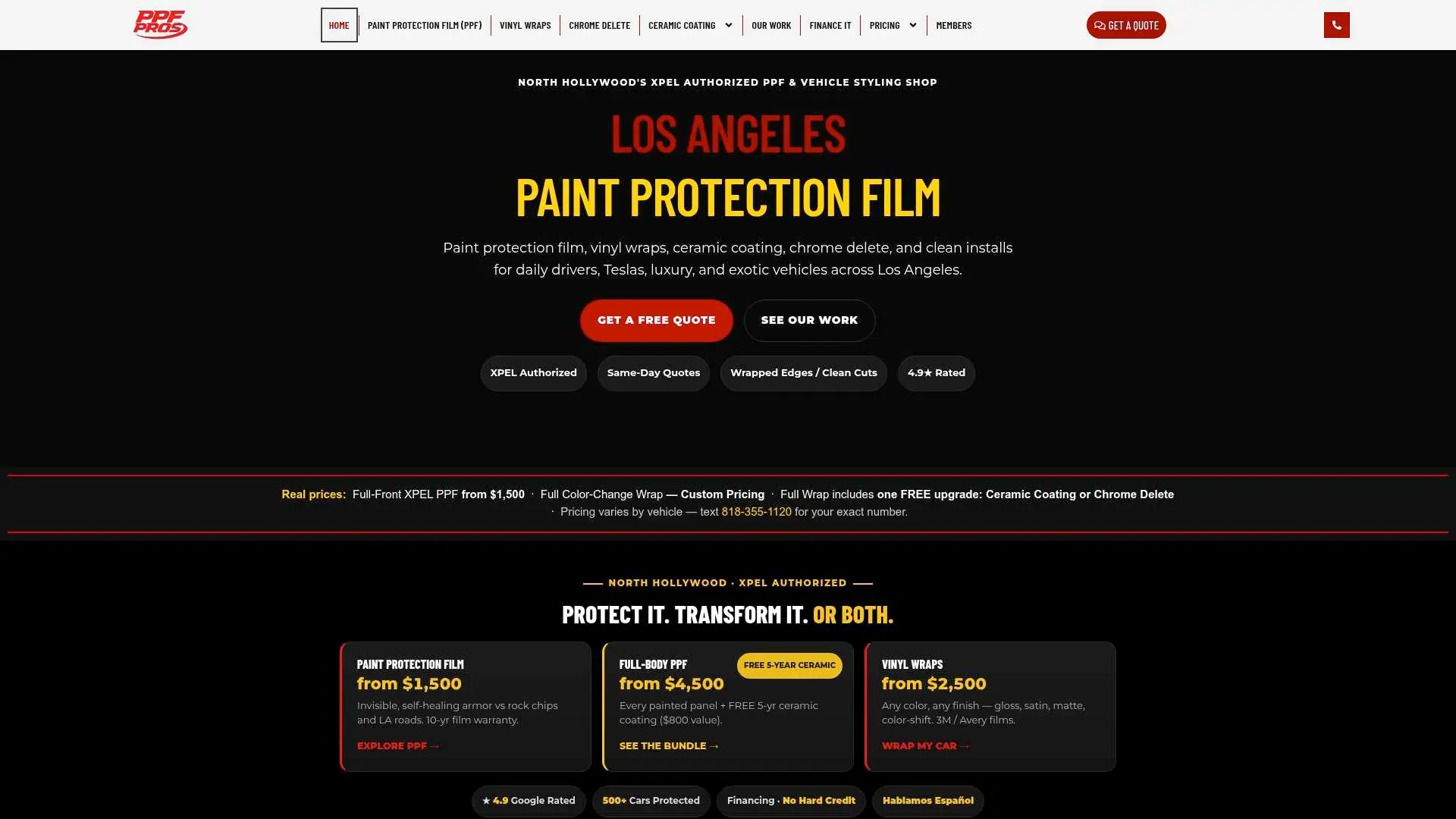
To get a fast, accurate quote, have your vehicle’s year, make, and model ready along with your mirror cap type and how much coverage you want, mirrors only, a full front package, or a full vehicle wrap. Our Full Front package is $2,199 one-off, and our full paint protection film services page covers Partial Front and Track Pack options with quotes available on request. Reach out with your vehicle details and we will walk you through coverage and pricing before you book.
FAQ
What is the downside of PPF?
PPF requires careful surface prep and correct installation temperature to bond well, and a rushed or poorly sealed edge can lift over time. Choosing a wrapped edge or a properly sealed surface cut, done within the recommended 70°F to 79°F range, avoids most of these issues.
What is a mirror coating?
“Mirror coating” sometimes refers to a safety backing film applied to the reverse side of a mirror, which is a different product from exterior automotive PPF. Mirror safety backing films use different materials and adhesives than the clear PPF applied to painted mirror caps.
What is the average cost to PPF a car?
Cost depends heavily on coverage level and vehicle size. At PPF Pros, a Full Front package is priced at 2199 USD one-off, while a Full Vehicle package starts from 4500 USD one-off.
Can you put mirror tint on a car?
Colored or tinted PPF is available as a product category, with thicker colored film lines offering a cosmetic change along with protection, according to XPEL’s FAQ. Whether a tinted finish suits your mirrors depends on local regulations for reflective surfaces, so check your own jurisdiction’s rules before choosing a colored film.
Sources
- 3M paint protection film installation guideline
- PPF installation guide for professional installers — KSB Window Film
- Frequently Asked Questions (FAQs) – XPEL Support